

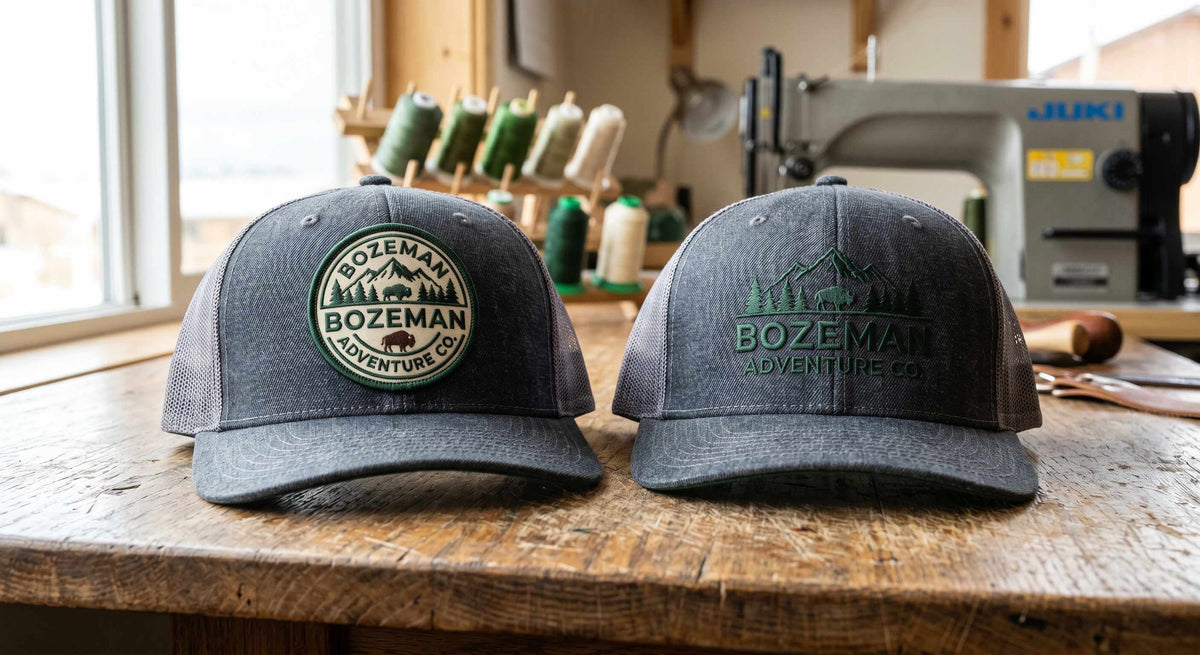
Key Takeaways
- An embroidered patch is stitched twill sewn onto the hat; direct embroidery is thread in the panel.
- The patch sits raised with a border and reads crafted; embroidery sits flush and reads quiet.
- A patch goes front, back, or sides, up to 6 by 3 inches.
- No minimum on either; patches take 4 to 6 weeks, embroidery 2 to 3.
Run a thumb across the front of the hat. If your thumb catches on a raised border and the logo sits on its own square of fabric, that is an embroidered patch hat. If the logo is flush with the panel and the fabric shows between the stitches, that is an embroidered hat, also called direct embroidery. The two names are nearly the same, the two products are not, and buyers order the wrong one often enough that this guide exists.
Below, we take each one apart and compare them side by side. We also cover where a patch can go on a hat, what it costs at small quantities, and when thread is the wrong material. We make both in-house, on hats and apparel, so the ordering section describes our own process. If you already know you want the patch look, you can browse custom patch hats and see your logo on the hat before you order.
Table of Contents
- What Is the Difference Between an Embroidered Patch Hat and an Embroidered Hat?
- How Is an Embroidered Patch Made?
- How Is Direct Embroidery Made?
- Same Logo, Two Different Looks
- Where Can an Embroidered Patch Go on a Hat?
- Which Hat Styles Take an Embroidered Patch Best?
- Embroidered Patch or Direct Embroidery: How to Decide
- When Is an Embroidered Patch the Wrong Call?
- How to Order an Embroidered Patch Hat
- Frequently Asked Questions About Embroidered Patch Hats
- Raised or Flat: Pick the One That Matches the Brand
What Is the Difference Between an Embroidered Patch Hat and an Embroidered Hat?
An embroidered patch hat carries a patch. The patch is a piece of twill stitched with your logo first, finished with a border, and then hand-sewn onto the hat. An embroidered hat has no patch. The needle drives thread straight through the hat's panel into a backing behind it, so the design lives in the fabric. Both are made of thread. One is a layered object sitting on the hat, the other is a surface the hat now has.
That difference is easy to see and easy to feel. The patch sits raised off the crown with a visible edge, and on a curved front panel it reads as a distinct, dimensional piece. Direct embroidery sits flush, follows the curve of the panel, and disappears into the weave from a few feet away.
| What you are comparing | Embroidered patch hat | Embroidered hat (direct embroidery) |
|---|---|---|
| What it is | A stitched twill patch, hand-sewn onto the hat | Thread stitched into the hat's panel |
| How it sits | Raised, with a visible border | Flush with the fabric |
| How it reads | Crafted, vintage, deliberate | Clean, quiet, uniform |
| Where it goes on a hat | Front, back, or sides | Front, back, sides, or the strap |
| Raised (3D puff) lettering | Yes, on the patch base | Yes |
| Standard production | 4 to 6 weeks from proof approval | 2 to 3 weeks from proof approval |
| Minimum order | None; one hat is a real order | None; one hat is a real order |
| If the logo changes | The patch can be unpicked and replaced | The hat is replaced |
An embroidered patch is one of five patch types we make, alongside leather, PVC, woven, and sublimated. Our patch hats guide compares all five by logo, look, and wear. This page covers only the embroidered patch and how it differs from direct embroidery.
How Is an Embroidered Patch Made?

The patch starts as a piece of tight twill in the background color you choose. The embroidery machine stitches your logo across that base, building fills, outlines, and lettering thread by thread. The patch base can carry standard flat embroidery or 3D puff, where dense foam under the stitches lifts bold letters off the surface. You choose the background color and the border color separately. A navy patch with a gold border on a tan hat is one design, with no extra step.
Then the edge is finished, and this is the choice most buyers do not know they are making. A merrowed edge is a wrapped overlock stitch run around the whole perimeter, which leaves a visible rope of thread at the border. It reads traditional and rugged, the look fire departments, athletic teams, and heritage outdoor brands usually want. A laser-cut edge, sometimes called hot-cut, is sealed flat as it is cut, so the patch has a thinner, cleaner rim. It suits modern marks and any shape with tight interior curves, where a wrapped border cannot follow the outline.
The finished patch is hand-stitched onto the hat with a line of thread run through the panel. We hand-stitch every patch, on every product, and that stitching is what holds the patch on for the life of the hat. Nothing is glued and nothing is ironed on. Your design proof shows the finished patch, edge included, before we make anything. If you want to see the patch look on a specific cap first, shop custom patch hats and open any product page.
How Is Direct Embroidery Made?

Direct embroidery skips the patch. A cap frame clamps the hat in place and a multi-needle head loaded with your thread colors drops into position. The machine drives each stitch through the panel into a backing that steadies the area. When the needle stops, the design is finished and part of the cap. There is no separate piece, no border, and no edge to catch a thumb on.
What the result looks like comes down to how the thread sits. Standard flat embroidery lies flush and holds the most detail. 3D puff adds foam under the stitches for raised block lettering, and chain stitch gives a looped, hand-worked texture. All three are direct embroidery, and all three read quieter than a patch because there is no border framing the logo. If the flush, integrated look is what you want, browse custom embroidered hats instead.
Same Logo, Two Different Looks

Take one wordmark with a strong icon. Stitched directly into a navy trucker, it reads crisp, quiet, and corporate, the kind of hat a sales team hands out at a conference. Build the same wordmark as an embroidered patch on a twill square with a merrowed border and put it on the same trucker. Now it reads vintage, crafted, and deliberate. People ask where you got it.
A buyer with a mood board is usually reaching for that second read. The objection is rarely to direct embroidery itself. The patch look is half the branding, and stitching straight into the crown cannot produce a border, a background color, or that raised square. If your logo would look at home on a work shirt chest or a tackle box, the patch is probably right. If the design should feel like part of the hat, direct embroidery wins.
Where Can an Embroidered Patch Go on a Hat?

An embroidered patch goes on the front, the back, or either side of a hat. That includes the mesh back of a trucker, where the patch is hand-stitched to the mesh above the closure. The one placement a patch does not take is the adjustable strap, which is embroidery and printing only. A design with a small logo on the side and a wordmark on the back can be all patches, all direct embroidery, or a mix. The photo above shows a common mix: a patch on the front with embroidery on the side.
Size limits are in inches and are production limits, so the exact size is confirmed on your proof.
- Front: up to 6 by 3 inches, the largest patch a hat takes.
- Front left or front right panel: up to 2.75 by 2 inches.
- Back, above the closure: up to 4 by 2 inches.
- Left or right side: up to 3 by 2 inches.
Every side you use counts as its own placement with its own per-hat cost, whichever method it carries. A front patch with a side embroidery is priced as two placements, so a second mark is a real decision rather than a free extra.
Which Hat Styles Take an Embroidered Patch Best?
Structured trucker caps, 5-panel caps, and flat bills carry an embroidered patch cleanly. The stiff, flat front panel gives the patch a stable surface, so it sits square and its edge reads sharp. Dad hats and other unstructured caps take a patch too, with a softer read. The panel relaxes with the hat, and the patch relaxes with it.
Beanies take a patch as well, hand-stitched onto the knit like on every product. Every beanie placement is up to 4 by 2.3 inches. A simple patch shape holds its outline best against a surface that stretches on the head. Direct embroidery works on all of these styles, so hat style rarely settles the choice on its own. It changes how the patch reads, from crisp on a foam-front trucker to relaxed on a washed dad hat.
Embroidered Patch or Direct Embroidery: How to Decide
Three practical factors settle most of these orders before taste enters the room.
Order size and cost. You can order a single hat of either method, and what changes with quantity is the per-unit price. Every patch run carries a setup cost that spreads across however many hats you order. A single patch hat pays all of it, and the per-unit price falls as the run grows. Direct embroidery has no patch to make first, so its per-unit price is lower from the first hat and stays flatter across the range. On a small team order or a first pop-up, direct embroidery is usually the better math. As the order grows, the two get close, and the look decides.
Timeline. Standard production is 4 to 6 weeks for patch methods and 2 to 3 weeks for embroidery, counted from proof approval. The patch has to be made before it can be sewn on, and that is where the extra weeks go. If your date is tight, direct embroidery buys back weeks a patch run cannot. Rush is available on request for either method. Contact us by phone, email, or live chat before you order, and we confirm what is possible for your date.
The look. When cost and dates are close, this is the whole decision. A patch reads as merch a customer would pay for. Direct embroidery reads as a uniform or a clean corporate mark. Pick the one that matches how the brand wants to be seen on someone's head.
When Is an Embroidered Patch the Wrong Call?
An embroidered patch is thread, and thread has a floor. Small lettering, hairline serifs, and thin line work close up into a fuzzy ridge, on a patch and in direct embroidery alike. That floor moves with the font: a clean, open sans-serif holds smaller than a condensed, thin-stroke, or script face. Your proof is where we check the smallest type in your logo against the patch size.
When the logo depends on that fine detail, a different patch holds it. A woven patch is made on a loom instead of an embroidery machine, so one thread can carry a serif. Our guide to woven patch hats covers what it holds and what it does not. Photographic logos and smooth gradients do not translate into thread at all; a sublimated patch or printing handles those.
The other case is a brand that wants the logo to disappear into the hat. If the design should be felt more than seen, a border and a raised square work against it, and direct embroidery is the honest answer.
How to Order an Embroidered Patch Hat
Open a hat's product page, click "Start designing," pick the side, and choose Patch as the customization method in the Design Studio, then Embroidered. Upload your logo as a PNG or JPEG, or build one from text and shapes. You see it on the hat before you add it to the cart. Any other file type can be emailed to custom@griwolfe.com and we bring it in for you.
After you order, we email a design proof within 1 to 2 business days, with unlimited revisions before anything is made. The proof shows the patch background, the border, and the edge finish, and it confirms the size in inches.
There is no artwork fee, no setup fee, and no minimum, so one hat is a real order. Ordering one is how to check the patch before a larger run. A 1-unit patch hat costs more per unit than the same hat in a run, and 1-unit orders are not refundable. U.S. shipping is free. We make custom hats and apparel in-house in Greensboro, North Carolina, and custom bags are coming.
Frequently Asked Questions About Embroidered Patch Hats
Is an embroidered patch more durable than direct embroidery?
On the hat itself, both are close to permanent under normal wear. The difference is what happens when something does go wrong. A patch that frays or fades can be unpicked and replaced without touching the cap. Direct embroidery is the cap: if the design needs to change, you replace the hat, not the stitching.
Should I pick a merrowed edge or a laser-cut edge?
Merrowed reads traditional and gives the patch a visible rope of thread around the border. It is the default for uniformed groups, athletic teams, and heritage brands. Laser-cut reads modern, sits with a thinner rim, and follows shapes a wrapped border cannot, like tight stars or interior curves. Your proof shows whichever you choose on the finished patch.
Can I put an embroidered patch on the back of a hat?
Yes. A patch goes on the front, back, or sides of a hat. That includes the mesh back of a trucker, where it is hand-stitched above the closure. The back box is up to 4 by 2 inches. The only placement a patch does not take is the adjustable strap.
Why does an embroidered patch cost more per unit than direct embroidery at low quantities?
Each patch run carries a one-time cost to make the patches, and at a handful of hats that cost spreads across a few units. Direct embroidery skips that step, so its per-unit price is lower from the first hat. Neither method has a minimum, so the question is price rather than eligibility. Patch cost per unit falls as the quantity grows, while embroidery stays flatter, and the two converge on larger orders.
Can an embroidered patch have 3D puff lettering?
Yes. The patch base takes standard flat embroidery or 3D puff, so raised block letters on a bordered patch are one design. Puff wants thick letterforms, because fine lines and small text sink into the foam. A logo with both usually runs the wordmark in puff and the small elements flat.
Raised or Flat: Pick the One That Matches the Brand
An embroidered patch hat is a different product from an embroidered hat, built differently and chosen for a different reason. The patch is a stitched piece of twill with a background color, a border, and a merrowed or laser-cut edge. It is hand-sewn onto the front, back, or side of the hat, and it reads as merch. Direct embroidery puts the thread in the panel and reads as a uniform. Pick the patch when the patch look is part of the branding and the date allows 4 to 6 weeks. Pick direct embroidery when the order is small, the date is tight, or the logo should feel like part of the hat. Either way, you can design your custom patch hat in the Design Studio and see it on the hat before you commit.
Share:
Sublimated Patch Hats: Gradients and Photos on Any Hat Color
Custom Work Shirts: Fabric Weights, Logo Size, Crew Sizing