

Key Takeaways
- The full-color print is on a separate white polyester patch, not on the hat. A gradient or a photo logo works on a black cap, a cotton dad hat, or a knit beanie.
- Sublimation prints no white. Every white part of your logo is bare patch fabric, which is why the patch starts white.
- It is the only patch type with no color limit. It is the wrong one for heritage brands, fine text, or a small logo on a dark hat.
- We hand-stitch every sublimated patch, and there is no minimum.
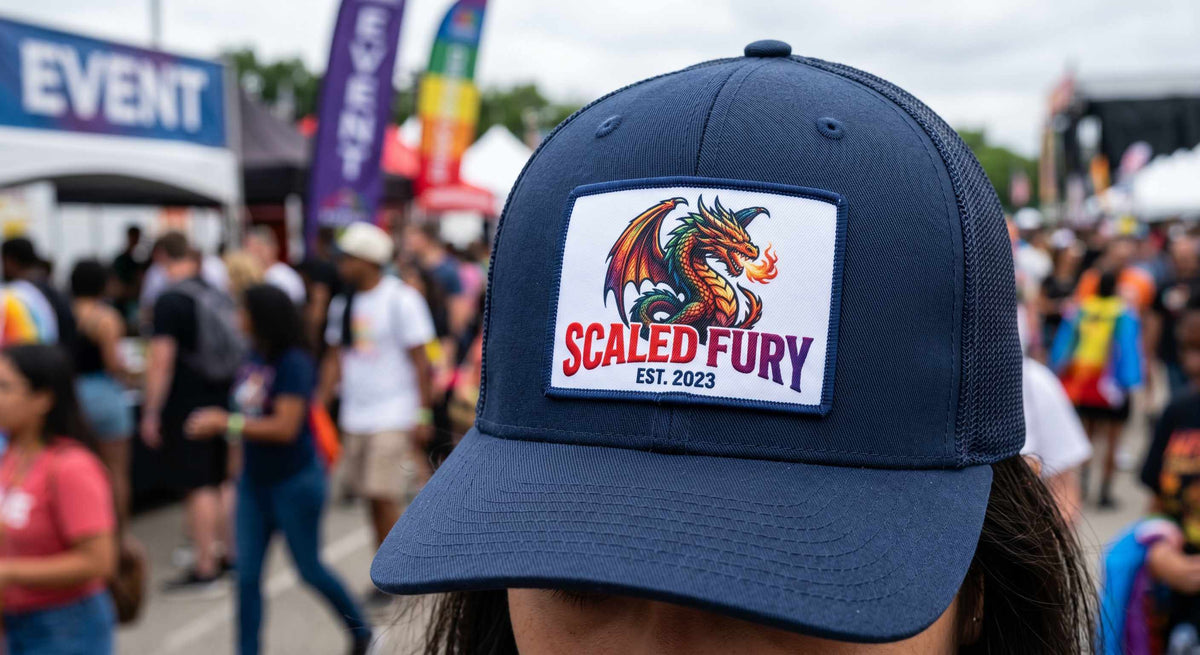
On a sublimated patch hat, the full-color print is on the patch, not on the hat. The patch is a small piece of white polyester fabric with your logo printed into it, finished first and then hand-stitched onto the cap. That is why a photo, a smooth gradient, or a logo with twenty colors can sit on a black trucker or a cotton dad hat. Neither fabric could be sublimated on its own.
The sections below explain how the patch is made and why it has to be white polyester, then compare it with an embroidered patch. They cover what artwork prints well, which hat styles suit it, and the size limits in inches. They also cover how it holds up in sun and wash, and when another patch type is the better call. We make every sublimated patch hat in-house, so the ordering section describes our own process.
Table of Contents
- What Is a Sublimated Patch, and How Is It Made?
- Why Is the Patch White? There Is No White Ink
- Can a Sublimated Patch Go on a Black Hat?
- Sublimated vs. Embroidered Patch: Which Holds Your Logo?
- What Artwork Prints Well on a Sublimated Patch?
- Which Hat Styles Take a Sublimated Patch?
- How Big Can a Sublimated Patch Be, and Where Does It Go?
- How Does a Sublimated Patch Wear and Wash?
- When Is Sublimated the Wrong Call?
- How to Order a Sublimated Patch Hat
- Frequently Asked Questions About Sublimated Patch Hats
- Print the Logo You Have
What Is a Sublimated Patch, and How Is It Made?

A sublimated patch is a piece of white polyester twill with your artwork printed into the fabric in full color. A sublimation printer lays the design on transfer paper in a special dye. When the paper is pressed against the polyester under heat, the dye turns straight from a solid into a gas. The fibers open and take the color in. Once the patch cools, the color is inside the fibers, with nothing sitting on the surface.
That dye is the reason the process only works on polyester. It belongs to a class called disperse dyes, developed for synthetic fibers. Joonseok Koh's chapter on dyeing with disperse dyes (Konkuk University, 2011) describes the step at the heart of every sublimated patch. In his words, "the disperse dyes begin to sublime and the polyester fibres absorb their vapours" as the fabric reaches temperature. Cotton, wool, and leather do not absorb the vapor, so on those fabrics the color would sit on top and wash away.
The finished patch is flat and soft, closer to a printed fabric label than to a stitched patch. A thread border is stitched around the edge in a color you choose, and we hand-stitch the whole patch to the hat. It can go on the front, the back, or either side.
A sublimated patch hat is a different product from a sublimated hat. On an all-over sublimated cap, the whole hat is polyester and the print runs edge to edge. On a patch hat, only the patch is printed, and the hat underneath can be any fabric and any color.
Sublimated is one of five patch types we make, alongside leather, PVC, woven, and embroidered patches. Our patch hats guide compares all five by logo, look, and wear. If your logo has a gradient or a photo, browse custom patch hats and open any product page to see it on the hat.
Why Is the Patch White? There Is No White Ink
Sublimation printers have no white dye. Every color is transparent and tints whatever fabric is underneath, so the print only reads true on a white base. On black fabric the same dye would come out dark and muddy. That is why nearly every sublimated patch starts as white polyester twill.
Two things follow for your design. First, every white element in your logo is unprinted patch fabric showing through: a white outline, white lettering, a white shape. Second, a colored patch is a printed background. A navy field behind a gold mark is still a white patch underneath. The printer lays the navy down and leaves the gold and any white where you drew them.
A printed black background works for the same reason, because the black is dye on white twill like everything else. Pale backgrounds are the one thing to think twice about. A light gray or pastel field prints fine, but it dulls every color on top of it a little, and a photo loses some punch. Keep a photo on white or on a strong color.
Can a Sublimated Patch Go on a Black Hat?
Yes. The patch is printed and finished before it ever touches the hat, so the hat's color and fabric make no difference. A black structured trucker, a wool-blend beanie, a cotton dad hat, or a performance cap can each carry a full-color gradient patch. None of them is being sublimated; only the patch is.
Other companies list sublimated patch hats without saying where the print is. A buyer with a gradient logo and a black brand color is left unsure whether it can be done. It can. The white patch on a dark panel becomes part of the design: a bright printed field with a stitched border, framed by the hat color.
If a white patch on a dark hat is not the look you want, there are two fixes. Print a background color to the edge of the patch, or pick a border thread that matches the hat. Either way the patch stops reading as a white shape. Both show on your proof before anything is made.
Sublimated vs. Embroidered Patch: Which Holds Your Logo?

The most common comparison is against an embroidered patch. Both are fabric patches with a stitched border, both are hand-stitched to the hat, and both carry no minimum. They differ on nearly everything else.
| Sublimated patch | Embroidered patch | |
|---|---|---|
| How the logo is made | Dye printed into white polyester twill | Thread stitched on top of a fabric patch base |
| Colors | No limit | About 7 to 8 thread colors |
| Gradients and photos | Prints both as drawn | Flat blocks of thread; no photos |
| Small text | Prints fine strokes; we check the size on your proof | Small letters close up; the floor depends on the font |
| Surface | Flat, printed into the fabric | Raised thread with visible stitches |
| Feel | Light, nearly flush with the hat | Thicker, with weight and texture |
| Best for | Photos, gradients, mascots, more than eight colors | Bold wordmarks, crests, the classic twill-and-thread look |
| Minimum order | None, order 1 | None, order 1 |
An embroidered patch wins when the logo simplifies into flat color blocks and the raised, stitched texture is part of the appeal. A chunky wordmark, a shield, or a two-color team crest looks right in thread and reads as a classic patch from across a room.
A sublimated patch wins when the logo will not simplify. A photographic mascot, a smooth fade from red to purple, a painted illustration, or a mark with a dozen colors all print as drawn. A gradient rebuilt in thread turns into bands of the nearest colors, and a photo cannot be stitched at all. Choosing between the two happens in the Design Studio: upload your logo, pick Patch, and choose Sublimated or Embroidered.
What Artwork Prints Well on a Sublimated Patch?

Almost any artwork that shows on a screen will print on a sublimated patch, with three things to check before you upload. They matter more here than for embroidery, because a print shows every softness in the file.
Start from the sharpest version you have. Wordmarks, icons, and line art come out best from vector art or a high-resolution export of it. Photographs need to be large and sharp. A quick test: shrink your logo on screen to about the width of a credit card, roughly the size of a typical front patch. If the edges stay clean at that size, the patch will hold them. A small file stretched up to patch size comes back with soft edges. Upload a PNG or a JPEG in the Design Studio, and email any other format to custom@griwolfe.com so we can bring it in.
Screen color and printed color are not the same. A screen glows and fabric does not, so a bright screen red can land slightly orange and a deep screen blue slightly purple. For a brand-critical color, send the Pantone number with your artwork. Patch colors are matched to the Pantone value you give us, and the design proof shows the result before anything runs.
Fine text and hairline strokes. A print holds thin lines better than thread does, but the finest strokes can still soften at patch size. We do not publish a minimum text height for sublimation, because the honest answer depends on the typeface and the artwork. We check your art on the proof and tell you if a line or a letter is too thin to hold.
Two other things can go wrong. Gradient banding is a smooth fade coming back as visible color steps, usually because the file was saved with too few colors. It shows on the proof, so the file gets fixed before printing. Ghosting is a faint offset shadow left by a paper that shifted during the press. We check every patch for it before it is stitched on.
Which Hat Styles Take a Sublimated Patch?

Because the patch is made separately, a sublimated patch works on more hat styles than any other patch type. It looks best on a flat, firm front panel where the whole print sits square, and it reads softer on an unstructured crown.
Structured truckers. These are the default pairing. A flat foam or twill front holds the patch edges clean, and the Richardson 112 is a common choice for sublimated patch orders. It has a structured six-panel crown, a 60/40 cotton and polyester front, a polyester mesh back, a pre-curved bill, and a snapback. Browse custom trucker hats for the full range.
5-panel caps and flat bills. A flat front takes crisp patch edges with no pillowing. Streetwear and lifestyle brands pick these for bold gradient designs.
Performance caps. A performance cap is a natural home. A thin printed patch adds almost no weight to a moisture-wicking cap, and a bright full-color mark matches the sporty read. Running clubs, youth leagues, and esports teams tend to land here.
Dad hats. The unstructured front curves gently under the patch, so the edges read softer. Good for lifestyle brands that want a relaxed hat with a loud logo.
Beanies. We hand-stitch the patch through the knit on the cuff, like every patch we make. Keep the shape simple, a circle, a rectangle, or a shield, so the border sits flat.
Rope hats and 7-panel caps. Both take a sublimated patch, and both usually look better with something else. These styles read heritage and outdoor, and a bright printed patch pulls against that. Leather or woven is usually the better call unless the logo itself is a photo.
How Big Can a Sublimated Patch Be, and Where Does It Go?
A sublimated patch goes on the front, the back, or either side of a hat, including the mesh back of a trucker. Each placement has a size limit in inches. The front takes a patch up to 6 inches wide by 3 inches tall, starting half an inch above the bill seam. The back, above the closure, takes up to 4 by 2 inches, and each side up to 3 by 2. On a beanie every placement is 4 by 2.3 inches, centered on the cuff.
| Placement | Largest sublimated patch (width by height) |
|---|---|
| Front of a structured cap | 6 by 3 inches |
| Back, above the closure | 4 by 2 inches |
| Left or right side | 3 by 2 inches |
| Beanie cuff, any placement | 4 by 2.3 inches |
Size matters more for a sublimated patch than for most, because a photo or a detailed illustration needs room to read. A mascot with a face belongs on the front, where it has the room. A simple gradient mark or a two-color fade is fine on a 3 by 2 inch side patch. Fill the front panel edge to edge and the patch looks crowded, so most sit well inside the box.
The exact size and shape are set on your design proof, where you see the patch at scale on the hat. A photo that looks sharp on a screen can feel busy on a cap, and the proof is where you find that out. A sublimated patch up front also pairs with embroidery on a side or the back. A full-color logo and a stitched name can share one hat.
How Does a Sublimated Patch Wear and Wash?
A sublimated patch wears well because the color is inside the polyester fibers. There is no printed layer on the surface to crack or peel, and no raised stitching to snag. The hand-stitched border keeps the patch on through wear and washing. An ironed-on patch depends on a glue that softens with heat, which is how corners start to lift.
Sun is the honest limitation. Long stretches of direct sun soften sublimated color over time, and people who wear sublimated back patches on jackets say the same (r/BattleJackets, 2026). A cap that lives on a dashboard will show it first. When the color does go, it goes slowly and evenly. There is no cracking or peeling, and no fraying the way thread does.
The other thing first-time buyers notice is that it is flat. Next to a raised embroidered patch, some people read a printed patch as plainer or cheaper. That flatness is the trade for the photo. If your logo would look as good in thread, an embroidered patch gives you the texture. If it would not, the print is the only patch that shows it.
Care is simple. Wipe the patch with a damp cloth. If the hat needs a wash, hand-wash it in cool water with a mild detergent and let it air-dry. Skip the dryer, and keep a hot iron off the patch face, because heat can shift the color the same way it put it there.
One thing to ask any company you get a quote from: what is the color printed on? Some shops sublimate straight onto the foam front of a trucker rather than onto a separate polyester patch. The two look alike on delivery day, and the base material is not the same. Our sublimated patches print on polyester twill and are hand-stitched to the hat.
When Is Sublimated the Wrong Call?
Sublimated is the only patch type with no color limit, which makes it sound like the safe upgrade. It is the wrong call in four situations, and each has a better patch or method.
- Your brand voice is heritage, rugged, or tactile. A flat printed patch does not feel expensive in the hand the way a debossed leather patch or a raised 3D PVC patch does. Bourbon, ranch, outdoor, and trades brands usually want leather.
- Your logo carries fine text. A tagline set well below the main mark, a legal line, or hairline serifs read sharper on a woven patch, which holds finer detail. A single thread in the weave can carry a serif. Woven gives up the gradient and keeps the fine print.
- Your logo is small and simple on a dark hat. A one-color wordmark on a black cap reads cleaner as direct embroidery or as an embroidered patch on dark twill. The white patch fights a minimal design.
- You want one or two hats with a plain logo. There is no minimum on any method, but a 1-unit patch order costs more per unit because the patch is set up and made first. For a photo or a gradient, sublimated is still the right patch at any quantity; expect the higher per-unit price on one.
Sublimated is the right call when the artwork is the point. That means a photo, a fade, a painted mascot, or a logo with more colors than thread can carry. Youth sports, gaming, festivals, and creative brands pick it for that reason.
How to Order a Sublimated Patch Hat
Open a hat's product page, click "Start designing," pick the side, and choose Patch as the customization method in the Design Studio, then Sublimated. Upload your logo as a PNG or JPEG, or build one from text and shapes. You see it on the hat before you add it to the cart. Any other file type can be emailed to custom@griwolfe.com and we bring it in for you.
After you order, we send a design proof within 1 to 2 business days, with unlimited revisions before anything is made. The proof is where we check the smallest type, confirm any Pantone value you sent, and show the border color against the hat.
Standard production for patch hats is 4 to 6 weeks from proof approval. Rush is available on request: contact us by phone, email, or live chat before you order, and we confirm what is possible for your date. There is no artwork fee and no setup fee, and U.S. shipping is free.
There is no minimum, so one hat is a real order. Ordering one is how to see a photo patch on the actual hat before a larger run. A single patch hat costs more per unit than the same hat in a run, and 1-unit orders are not refundable. We make custom hats and apparel in-house in Greensboro, North Carolina, and custom bags are coming.
Frequently Asked Questions About Sublimated Patch Hats
Why can't sublimation print on a cotton hat directly?
Sublimation dye turns into a gas under heat and is absorbed by polyester fibers as they open. Cotton, wool, and leather do not absorb it, so the color would sit on the surface and wash out. A sublimated patch gets around this by printing on polyester twill first, then hand-stitching the finished patch to a hat of any fabric.
What kind of file does a photo logo need for a sublimated patch?
Send the largest, sharpest version you have, sized for the finished patch, which runs up to 6 inches wide on the front. Stretching a small file up to that size softens the edges. Upload a PNG or a JPEG in the Design Studio, and email any other format to custom@griwolfe.com so we can bring it in.
Can a sublimated patch have a dark background?
Yes, as a printed background. The patch fabric is white, and the printer lays a black, navy, or any other color field across it. Your logo and any white elements stay unprinted. Choose a dark background when the hat is dark and you do not want a white shape on the front.
Will a sublimated patch fade in the sun?
Over long, direct exposure, yes, and slowly. The color softens evenly rather than cracking or peeling, because it is inside the fibers. Normal wear, including sunny days, is fine. A cap that sits on a dashboard every day will show it first, so keep it off the dash between wears.
Why did the fine text on my sublimated patch come back blurry?
The strokes were thinner than the patch could hold at its finished size, or the file was small and got stretched. We check both on the proof before a patch is made and tell you if any lettering is too thin. Vector art, or a high-resolution export of it, gives the sharpest result on small type.
Print the Logo You Have
If your logo has a photo, a gradient, or more colors than thread can carry, pick a sublimated patch. Put it on whichever hat suits your brand. If the logo is bold and simple, or the brand is heritage, an embroidered, leather, or woven patch will serve it better. Either way the proof shows the patch on the hat before we make it.
When you are ready, design your custom sublimated patch hat on any hat in the collection. You see the patch on the hat before you order and a proof before we make it. Questions about an order? Contact us by phone, email, or live chat.
Share:
PVC Patch Hats: 2D vs. 3D Rubber, Exact Pantone, No Minimum
Embroidered Patch Hats vs. Direct Embroidery: Raised or Flat