

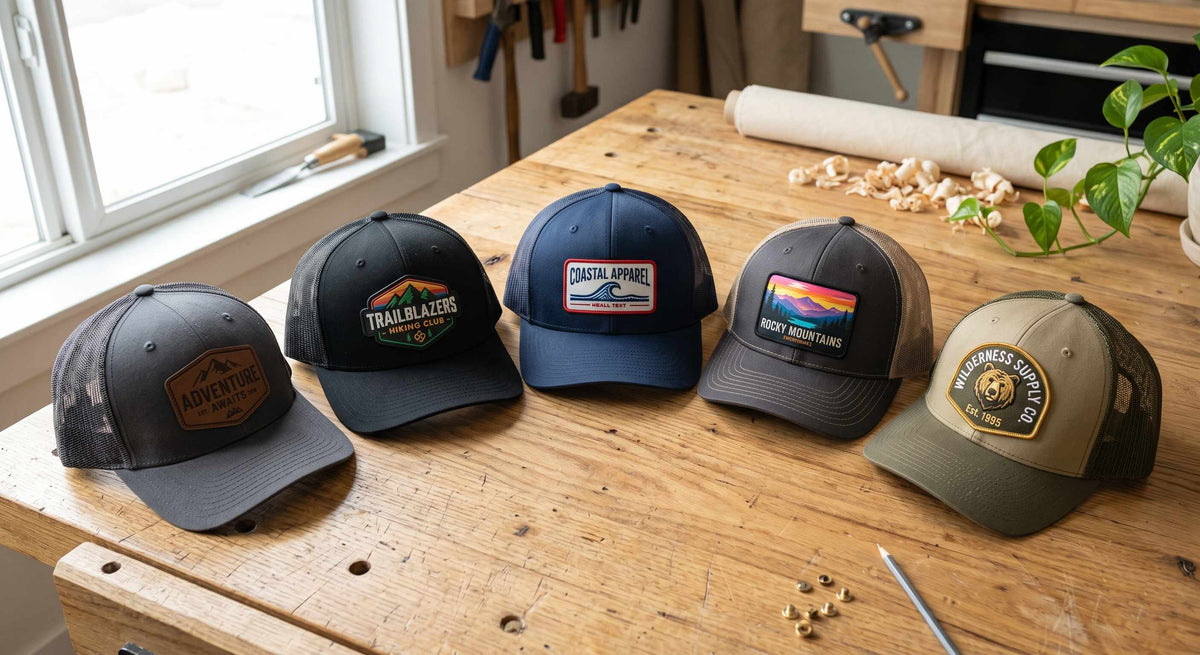
Key Takeaways
- Decide in order: what your logo needs, the look you want, then the hat style and where it will be worn.
- When two answers disagree, the logo wins, then the weather, then the look, then the price.
- Most ties come down to two types, such as leather and an embroidered patch, and each pair has one deciding question.
- Every patch type takes the same 4 to 6 weeks of standard production.
To choose a patch hat, answer three questions in order. Start with which patch types can hold your logo, then decide on the look you want. Finish with the hat style and where the hat will be worn. For a detailed or full-color logo, the first question rules out most of the five types on its own, so the last two go quickly.
We make five patch types: leather, PVC, woven, sublimated, and embroidered patch. Our patch hats guide describes each one. This article covers the step after that, when two or three look right and you need to pick one. It walks through the questions, a hat-style chart, the common close calls, and the order that breaks a tie.
Table of Contents
- How Do You Choose a Patch Hat?
- Question 1: Which Patch Types Can Hold Your Logo?
- Question 2: What Look Do You Want the Hat to Have?
- Question 3: Which Hat, and Where Will It Be Worn?
- Which Patch Types Suit Which Hat Styles?
- How Do You Decide the Common Close Calls?
- What If Two Patch Types Still Fit?
- How Are Patches Attached, and What Do You Choose?
- Frequently Asked Questions About Choosing a Patch Hat
- Which Patch Type Should You Order?
How Do You Choose a Patch Hat?
Choose a patch type by answering three questions in order: what your logo looks like, what look you want, and which hat it goes on. Each answer narrows the list. If all three point at one type, that is your patch. If two point different ways, the tiebreak order further down settles it.
- What does your logo look like? This decides which types can make it at all.
- What look do you want? This decides how the hat reads to the person holding it.
- Which hat, and where will it be worn? This decides whether the patch suits the style and holds up to the conditions.
The logo goes first because it is the only question with a hard answer. A patch type either holds your artwork or it does not, while look and hat style are matters of fit. Starting there keeps you from settling on a material that cannot carry the design. The tiebreak ranks where the hat is worn above the look, because sun and salt damage a patch however good it looked at first.
Question 1: Which Patch Types Can Hold Your Logo?

Your logo's colors, shading, and smallest details decide which patch types can make it. A bold one-color mark works on all five. Fine lettering points to woven, and a gradient or a photo points to sublimated. The table shows what each kind of logo rules out.
| Your logo has | Patch types that hold it | What it rules out |
|---|---|---|
| One color, bold letters, or a simple icon | All five | Nothing |
| Two to about eight flat colors | PVC, woven, embroidered patch, sublimated | Leather, which carries its own tone plus one optional color fill |
| Small lettering, a tagline, or thin lines | Woven first, then sublimated; laser-engraved leather for a one-color mark | PVC and embroidered patch, which round off or blur fine detail |
| A gradient, a photo, or more than about eight colors | Sublimated | The other four |
To place your own logo, shrink it on screen to the size of the patch and look at it from arm's length. A front patch runs up to 6 inches wide and 3 inches tall, and a side patch up to 3 by 2 inches. If the smallest words still read, most types will hold them. If they blur, the logo belongs on woven, or the small text should come off the patch.
An exact brand color does not narrow the list much. PVC, woven, and sublimated patches are matched to the Pantone number you give us, and leather takes a matched color fill. With the shortlist in hand, browse custom patch hats to see those types on real hats.
Question 2: What Look Do You Want the Hat to Have?

Each patch type sets the look of the hat before anyone reads the logo. Leather looks crafted and heritage, and PVC looks technical and outdoor. Woven looks quiet and precise, sublimated looks bright, and an embroidered patch looks classic, like a team or work uniform.
Leather is genuine or faux leather with the logo pressed in or laser engraved. It feels raised and solid in the hand. Genuine leather darkens and softens with wear, which suits a brand that wants its hats to age with the owner.
PVC and sublimated patches are the two built for color. PVC is soft molded rubber, flat in 2D or raised in 3D, with crisp blocks of color that read as gear made to be used. A sublimated patch prints full color into white polyester, so it stays flat and soft while every shade of the artwork shows. Some buyers find that flatness plainer than thread, which is the tradeoff for unlimited color.
Woven and embroidered patches are both made of thread, and they feel nothing alike. A woven patch is thin and flat, close to a garment label, and gets noticed for its detail. An embroidered patch is thread stitched onto a twill base, flat or raised with 3D puff, inside a stitched border. It has the familiar look of a uniform patch.
If the look you want and the logo disagree, keep the logo's answer and carry the look through the hat color and style. A heritage brand with a gradient logo can still get a warm read from a sublimated patch on an earth-tone hat.
Question 3: Which Hat, and Where Will It Be Worn?

The hat style and the conditions it will face settle the last part. Every patch type goes on every hat we carry, so this question is about fit and wear. Water, sun, and sweat matter most, because each one changes the five materials differently.
Hats worn in water, sun, and sweat all day are PVC territory. Rubber does not absorb water, so spray and sweat roll off, and it keeps its color in sun that fades thread and dries leather. Years on a dashboard or a boat console will still soften and dull it.
Leather is damaged by prolonged sun, salt from sea spray or dried sweat, and high heat. The Canadian Conservation Institute notes that long exposure to strong light, especially UV, weakens leather and makes it brittle. Faux leather wipes dry but can turn pale and stiff under hard sun, while genuine leather soaks up a splash and needs to air-dry.
Woven and sublimated patches carry the color inside the fabric, so there is no surface layer to crack or peel. Strong sun softens a sublimated patch's colors slowly and evenly over time. The Northeast Document Conservation Center notes that light damage to dyes adds up and cannot be undone.
The hat style works the same way. Rope hats and 7-panel caps already look traditional, so leather or an embroidered patch suits them. Performance caps suit PVC or sublimated, and leather looks borrowed from another kind of hat on technical fabric. On a beanie, the patch goes on the cuff, up to 4 by 2.3 inches, and a simple outline holds its shape best on knit.
Care is the same for every type: wipe the patch with a damp cloth, hand-wash the hat in cool water, and let it air-dry. Keep a leather patch out of the wash water, and wipe sweat off it after hot days.
Which Patch Types Suit Which Hat Styles?
All five patch types suit structured truckers, 5-panel caps, and flat bills, because their front panels are flat and firm. The differences show on rope hats, 7-panel caps, and performance caps. We make every combination in the chart. "Best fit" means the patch and hat share a look, and "Works" means it looks right. "Out of place" means it looks borrowed from another kind of hat.
| Patch type | Trucker | 5-panel | Flat bill | Dad hat | Rope | 7-panel | Beanie | Performance |
|---|---|---|---|---|---|---|---|---|
| Leather | Best fit | Best fit | Works | Works | Best fit | Best fit | Best fit | Out of place |
| PVC | Best fit | Works | Best fit | Works | Out of place | Works | Works | Best fit |
| Woven | Best fit | Best fit | Best fit | Works | Works | Works | Works | Works |
| Sublimated | Best fit | Works | Works | Works | Out of place | Out of place | Works | Best fit |
| Embroidered patch | Best fit | Best fit | Best fit | Works | Best fit | Works | Best fit | Works |
Dad hats read "Works" across the row because their soft, unstructured front curves under any patch and gives it a relaxed look. "Out of place" is a judgment about looks. If your logo only works as one type, the logo still wins, and the hat color can soften the mismatch.
How Do You Decide the Common Close Calls?
A close call is a choice between two types, and each common pair turns on one question. Leather against an embroidered patch is about how many colors the logo has. Woven against an embroidered patch is about the size of the smallest text, and leather against PVC is about the weather. The table covers six common pairs.
| Close call | Pick the first if | Pick the second if |
|---|---|---|
| Leather or embroidered patch | The logo is one color and you want a crafted feel that ages | The logo has two or more colors, or you want a team or uniform look |
| Woven or embroidered patch | The logo has small text, a tagline, or thin lines, or you want a flat patch | The logo is bold and you want raised thread you can feel |
| Leather or woven | The logo is one bold color and you want a raised, crafted patch | The logo has small text or several colors, or you want a thin, quiet patch |
| PVC or leather | The hat will face water, salt, or all-day sun | The hat sees everyday wear and you want it to age with the owner |
| PVC or sublimated | The logo is flat blocks of color and you want raised texture | The logo has a gradient, a photo, or more than about eight colors |
| Woven or sublimated | The logo is flat color with fine detail | The logo has shading or photographic detail |
Some buyers with small text still pick the embroidered patch for its classic look and accept that the smallest words will soften. Your proof shows how much before anything is made. A pair that still ties after its deciding question goes to the tiebreak order below.
What If Two Patch Types Still Fit?

When two patch types still fit, rank the questions: the logo beats where the hat is worn, which beats the look, which beats the price. If the ranking leaves a tie, order one hat in each finalist and decide with both in hand.
- The logo beats everything. If only one type can make the artwork, that type is the answer, and the look moves into the hat color and style.
- Where it is worn beats the look. A leather patch on a hat worn on a fishing boat every day will show salt and sun long before a PVC patch does.
- The look beats the price. A sublimated patch costs least from about six hats up and PVC costs most, and our custom hat pricing guide has the numbers.
- A tie that survives all three goes to a test order. There is no minimum, so one finished hat in each finalist is a real order. A single patch hat costs more per hat than a larger run and is not eligible for a refund.
An undecorated sample hat, available on request for a small fee plus shipping, shows the hat itself but not the patch. For a patch decision, the one-hat order is the test that answers the question.
How Are Patches Attached, and What Do You Choose?

Every patch we make is hand-stitched to the hat, with thread run around its edge and through the panel. Nothing is glued or ironed on. Attachment is therefore not part of the choice: all five types stay on the same way through washing, sweat, and sun.
What you do choose is the patch's edge, background, size, and placement. On woven, sublimated, and embroidered patches, you pick the border and background colors separately, so the border can match the hat. Patches go on the front, the back, or either side, including the mesh back of a trucker. A front patch runs up to 6 by 3 inches. The back takes up to 4 by 2 inches, and each side up to 3 by 2.
Your proof shows those choices at real size in inches, and we email it within 1 to 2 business days, with unlimited revisions.
Frequently Asked Questions About Choosing a Patch Hat
Which patch type lasts longest outdoors?
PVC lasts longest outdoors. Molded rubber does not absorb water, stays flexible from cold to hot, and holds its color through sun that fades thread and dries leather. A sublimated patch is the next choice when the logo needs full color. Leather is the type to avoid on hats that live in salt, heat, or all-day sun.
What is the safest patch type if I am not sure?
An embroidered patch on a structured trucker is the safest pick. It holds most logos except photos, gradients, and the finest lettering, and it suits every hat style we carry. Its classic uniform look suits most brands, and its price sits in the middle of the five types.
Can I order one hat of each patch type to compare?
Yes. There is no minimum, so you can order one finished hat in each of your finalists and decide with both in hand. A single patch hat costs more per hat than a larger run and is not eligible for a refund. To check only the hat itself, an undecorated sample is available on request for a small fee plus shipping.
Does the patch type change how long my order takes?
No. Standard production is 4 to 6 weeks for every patch type, counted from the day you approve your proof. Rush is available on request; contact us by phone, email, or live chat before you order and we will confirm what your date allows. If the date matters more than the patch look, flat embroidery and printing take 2 to 3 weeks.
My logo is mostly flat color with one small gradient. Which type fits?
A sublimated patch holds the logo exactly as drawn, gradient included. For PVC, woven, or an embroidered patch, the gradient has to become one or two solid colors. Our design team can do that if you ask on live chat, and your proof will show the flattened version first.
Which Patch Type Should You Order?
- A photo, a gradient, or more than about eight colors: sublimated.
- Small text, a tagline, or thin lines: woven.
- Water, salt, or all-day sun: PVC.
- A one-color mark and a heritage look that ages: leather.
- A bold logo and a classic look: embroidered patch.
When two still fit, the logo wins, then the weather, then the look, then the price. Every type is hand-stitched in-house, and standard production is 4 to 6 weeks from proof approval. We make custom hats and apparel in Greensboro, North Carolina, with bags coming. Design custom patch hats on any style and see your patch on the hat before you order.
Share:
Trucker Hat With a Patch: Structured, Foam, or Soft Front?
Leather Patch Hat Ideas: 15 Designs and What to Avoid