

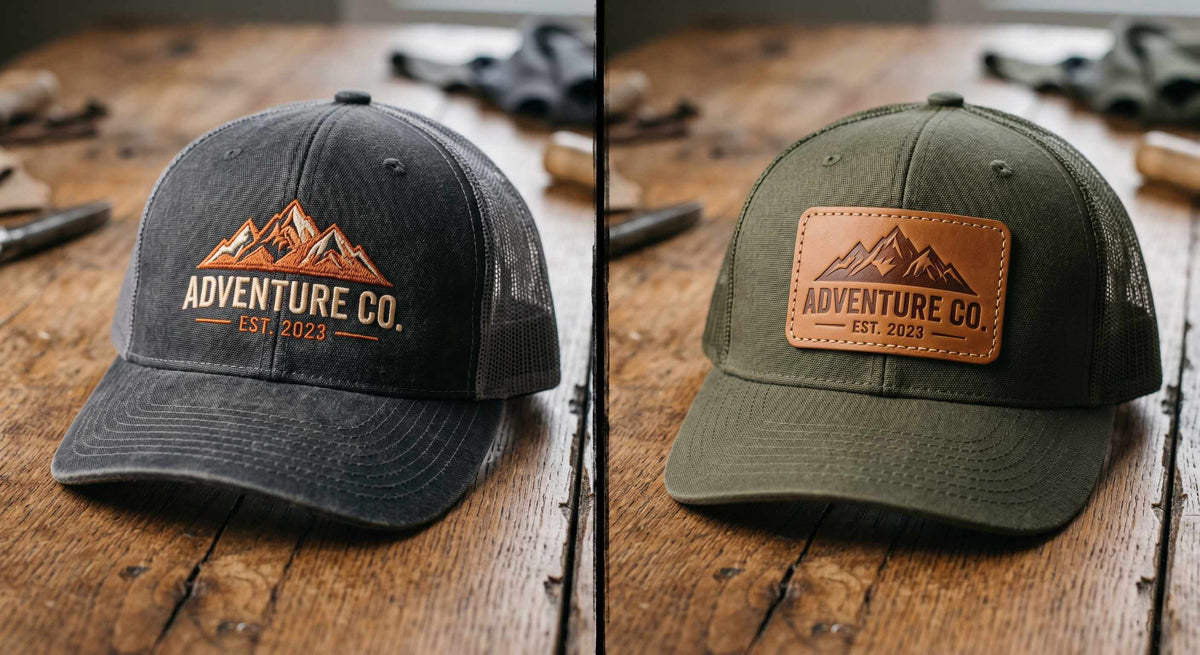
Key Takeaways
- Direct embroidery is thread stitched into the hat; a patch is made on its own and hand-stitched on top.
- Flat embroidery costs less per hat than most patches at every quantity. A sublimated patch is the one that catches up.
- Pick a patch for fine text, gradients, photos, or a bold merch look.
- Standard production is 2 to 3 weeks for embroidery and 4 to 6 weeks for a patch.
Choosing between embroidery and patch hats usually starts from one default. Direct embroidery costs less per hat and takes about half as long to make, so it is the safe pick for a clean logo. A patch is the one you choose on purpose. It fits a logo with detail thread cannot hold, or a hat meant to read as branded merch.
The sections below take three questions in their usual order: what your logo needs, the look you want, and what the budget and deadline allow. Neither method has a minimum order, and we make both in-house, so every limit and timeline here is our own.
Table of Contents
- What Is the Difference Between Embroidery and a Patch Hat?
- What Counts as a Patch?
- Which Logos Need a Patch?
- How Does Each One Look on a Hat?
- Which Costs Less, Embroidery or a Patch?
- Embroidery vs. Patch Hats Side by Side
- How Long Does Each One Last?
- Frequently Asked Questions About Embroidery vs. Patch Hats
- Which One Should You Order?
What Is the Difference Between Embroidery and a Patch Hat?

Direct embroidery is thread stitched straight into the hat, so the logo becomes part of the cap and sits flush with it. A patch hat carries a separate piece, made first from leather, PVC, woven fabric, printed polyester, or stitched fabric. We then hand-stitch that piece to the hat, where it sits raised with its own edge.
On the embroidery machine, a cap frame holds the hat. A multi-needle head then drives each thread color through the panel into a backing that steadies it. When the needle stops, the logo is already in the cap. There is no border and no second layer, and the thread texture catches the light.
A patch brings its own background, its own edge, and its own material to the hat. We sew every patch on by hand, with a line of thread through the panel. The two names people mix up most are embroidered patch and embroidered hat, and our embroidered patch hats guide separates them.
In short, embroidery lives inside the fabric and a patch sits on top of it.
Both methods go on the front, the back above the closure, and either side, including the mesh back of a trucker. Only a fabric strap takes embroidery and not a patch. On the full front, a patch can also run taller: up to 6 by 3 inches, against 6 by 2.3 for embroidery. Your proof confirms the exact size.
What Counts as a Patch?

A patch hat can mean any of the five patch types we make: leather, PVC, woven, sublimated, and embroidered patch. Each holds a different kind of logo and reads differently on the hat, and all five are hand-stitched the same way. For this decision, treat them as one side. Any of the five is the alternative to stitching the logo into the hat.
Two of them change the answers further down. A woven patch holds finer lettering than thread can, so it saves a logo that embroidery would blur. A sublimated patch prints full color, carries gradients and photos, and is the one patch type that competes with embroidery on price.
Choosing among the five is a separate decision, and our patch hats guide compares them by logo, look, and wear. To see them on real hats first, browse custom patch hats.
Which Logos Need a Patch?

Your logo decides first, because some artwork only one side can make. Tiny lettering and hairline detail call for a woven patch. Gradients, photos, and full-color art call for a sublimated patch or Printing. A logo in solid colors with clean shapes works either way, and the choice moves on to look and budget.
- Solid colors, clean shapes, readable lettering: either method. We recommend about 7 or 8 colors for embroidery, which can run up to 15, and most patch types sit in the same range.
- Tiny lettering, thin lines, fine serifs: a woven patch. Thread has a floor for small letters, on direct embroidery and on an embroidered patch alike. The floor moves with the font, since an open sans-serif holds smaller than a condensed, thin, or script face.
- Gradients, photos, or many colors: a sublimated patch, which prints full color with no limit. Printing, our third method, also puts full color straight onto the hat with no patch.
- An exact brand color: a patch. Patch colors match a Pantone color exactly, while embroidery thread is matched to the closest thread color we carry.
Thread comes in solid colors, so a gradient turns into bands of the nearest thread color and a photo does not translate at all. If you are unsure where your logo falls, build it in the Design Studio and look at it on the hat. Your design proof then shows it at its real size before we make anything, with unlimited revisions until you approve.
How Does Each One Look on a Hat?

Direct embroidery reads quiet, and a patch reads deliberate. Stitched into the crown, a logo looks like it belongs to the hat. A patch adds a border, a raised edge, and a change of material. Together they tell people the hat was made to carry a brand.
Embroidery is the expected look for corporate apparel, golf, and technical outdoor gear. Law firms, software companies, golf courses, and medical practices usually want the logo understated, and thread keeps it that way.
Patches lean the other way. Breweries, restaurants, ranches, outdoor lifestyle brands, streetwear labels, and private-label retail lines reach for them because the hat is meant to be noticed. Put the same one-color wordmark on two identical trucker hats, one stitched and one as a leather patch. The stitched hat reads like a staff uniform, and the patch hat reads like merch a customer would buy.
The embroidery side has a middle option. 3D puff embroidery stitches over a layer of foam, so thick lettering stands up off the panel. It reads bolder than flat thread, with no border added. It suits bold logos with heavy letters, and it carries less of the merch signal than a patch does.
Which Costs Less, Embroidery or a Patch?
In our price table, flat embroidery costs less per hat than a leather, woven, embroidered, or PVC patch at every quantity from 1 to 144. The gap is widest on a single hat and narrows as the order grows. A sublimated patch is the exception: it runs close to embroidery from about six hats and costs less per hat on a large run.
Many buyers expect a patch to be the cheap add-on, but the patch is what raises the price. Making one takes setup and tooling, and that cost weighs most on a small order. A single patch hat costs well above a single embroidered one, because we build that cost into the per-hat price instead of a setup fee. Embroidery has no separate piece to make, so its price starts lower and falls more gently.
Every price is per hat, with the customization method on each side included, and it falls as the quantity in a design group grows. A design group is hats that share one design, method, size, and placement. Patch size does not change the price. Our custom hat pricing guide lists the per-hat price of each method from 1 to 144 hats.
So cost alone rarely forces a patch. If the logo and the look work either way and the budget is tight, embroidery wins. If you want a patch for how it looks, the premium is smallest on the biggest runs. Raised 3D puff embroidery also costs more than flat, landing closer to a patch.
Time follows the same pattern. Standard production is 2 to 3 weeks for embroidery and 4 to 6 weeks for a patch, counted from the day you approve your proof. Rush is available on request for both: call, email, or open live chat before you order, and we confirm what your date allows.
To price both on your own hat, design custom embroidered hats. Enter a quantity and the product page shows the per-hat price, with your design included.
Embroidery vs. Patch Hats Side by Side
Every row below is Griwolfe's own production and pricing, current as of September 2026.
| Direct embroidery | Patch hat | |
|---|---|---|
| How it is made | Thread stitched through the panel into a backing | A separate piece made first, then hand-stitched on |
| How it sits | Flush with the crown | Raised, with a visible edge |
| Where it goes | Front, back, sides, and a fabric strap | Front, back, and sides (not the strap) |
| Largest front design | Up to 6 by 2.3 inches | Up to 6 by 3 inches |
| Colors | About 7 to 8 recommended, up to 15 | About 7 to 8 on most types; no limit on sublimated |
| Small lettering | Has a floor that depends on the font | Woven holds finer lettering than thread |
| Gradients and photos | Not possible | Sublimated patch |
| Brand color match | Closest thread color | Exact Pantone color |
| Cost per hat | Lower than leather, woven, embroidered, and PVC patches at every quantity | Higher, with the gap narrowing as the order grows; sublimated passes embroidery on large runs |
| Standard production | 2 to 3 weeks from proof approval | 4 to 6 weeks from proof approval |
| Rush | Available on request | Available on request |
| Minimum order | None | None; one patch hat costs more per hat |
| Design proof | 1 to 2 business days, unlimited revisions | 1 to 2 business days, unlimited revisions |
| Look | Quiet, part of the hat | Deliberate, branded |
We make both methods in-house in Greensboro, North Carolina, from the same Design Studio and the same proof process. The same floor makes our hats and apparel, with bags coming.
How Long Does Each One Last?

Both last for years of normal wear, and they age in different ways. Direct embroidery is part of the hat, so it wears along with the hat. A patch is its own piece, so how it ages depends on its material, while the hand-stitching holds it to the hat.
On an embroidered hat, the first wear shows at rub points, such as the edge of the logo where fingers grip to adjust the cap. Sun fades thread slowly, as it fades most dyed fabric; the Canadian Conservation Institute names UV light as a major cause of dye fading. A hat that rides on a dashboard ages faster than one that hangs on a hook.
Patches age by material. Genuine leather is the one that visibly changes, darkening and softening with wear, and PVC holds its color outdoors and wipes clean. Woven, sublimated, and embroidered patches wear the way fabric and thread do.
A hand-stitched patch does not peel. We sew every patch on with thread through the hat, with no glue and no iron-on backing, so there is nothing to let go.
Frequently Asked Questions About Embroidery vs. Patch Hats
Are patch hats better than embroidered hats?
Neither is better across the board. Direct embroidery costs less per hat, takes 2 to 3 weeks instead of 4 to 6, and suits a quiet, corporate look. A patch is the better pick when the logo has fine text, gradients, or a photo, or when you want a bold, bordered merch look.
Can one hat have a patch and embroidery?
Yes. Each side of the hat is designed on its own, with its own customization method. A leather patch on the front and embroidered initials on the side make one hat. Every extra side adds its own cost per hat, and your proof shows both sides before we make anything.
Can I mix embroidered hats and patch hats in one order?
Yes. Add both to the same cart and check out once. Each design prices as its own design group, so volume pricing does not combine across the two. Each one gets cheaper per hat as its own quantity grows.
Which is cheaper at 50 hats?
Flat embroidery, against most patch types. At about 50 hats it costs less per hat than a leather, woven, embroidered, or PVC patch. A sublimated patch lands close to it at that size and passes it on larger runs. The pricing guide's 48-hat column shows every method at that size.
Should I print my logo instead?
Printing is our third method: full color printed onto the hat itself, with no patch. It suits a full-color logo you want flush, the way embroidery sits, and standard production is 2 to 3 weeks. It does not go on mesh, so a trucker's mesh back takes embroidery or a patch.
Which One Should You Order?
Run your logo through the three questions and the answer usually falls out:
- Tiny lettering or hairline detail: a woven patch.
- Gradients, a photo, or full color: a sublimated patch, or Printing.
- A quiet logo that belongs to the hat: direct embroidery.
- A bold, bordered merch look: a patch.
- A tight budget or a close deadline: direct embroidery.
Open the Design Studio on the hat you like and build your logo; you see it on the real hat before you order. When you know which look you want, shop custom patch hats or stay with embroidery. Questions about an order? Contact us by phone, email, or live chat.
Share:
Carhartt Rain Defender vs Midweight Hoodie: Sized for a Crew
Trucker Hat With a Patch: Structured, Foam, or Soft Front?