

Key Takeaways
- Genuine leather darkens and softens with wear; faux keeps its first look, then wears out.
- Deboss suits bold wordmarks and simple icons; laser engraving holds finer lines and small text.
- A front patch runs up to 6 by 3 inches.
- Every leather patch is hand-stitched to the hat, and there is no minimum.
A leather patch is the one patch type that keeps changing after the hat leaves the box. Genuine leather darkens where fingers grip it and softens with wear. Faux leather holds its first look and then wears out. That difference sits behind the two choices a leather patch hat asks of you: genuine or faux, and debossed or laser engraved.
The sections below cover both choices. They also cover what a product photo never shows: telling genuine from faux, patch size, hat styles, what damages leather, and how to clean it. At Griwolfe we make every leather patch hat in-house and hand-stitch the patch to the hat, so the ordering section describes our own process.
Table of Contents
- What Is a Leather Patch Hat?
- Genuine vs. Faux Leather: How to Tell Them Apart
- Debossed vs. Laser Engraved: Which Finish Fits Your Logo?
- How Long Does a Leather Patch Hat Last?
- Which Hat Styles Take a Leather Patch Best?
- How Big Can the Patch Be, and Where Does It Go?
- How Do You Clean a Hat with a Leather Patch?
- How to Order a Leather Patch Hat
- Frequently Asked Questions About Leather Patch Hats
- Pick Your Leather and Your Finish
What Is a Leather Patch Hat?
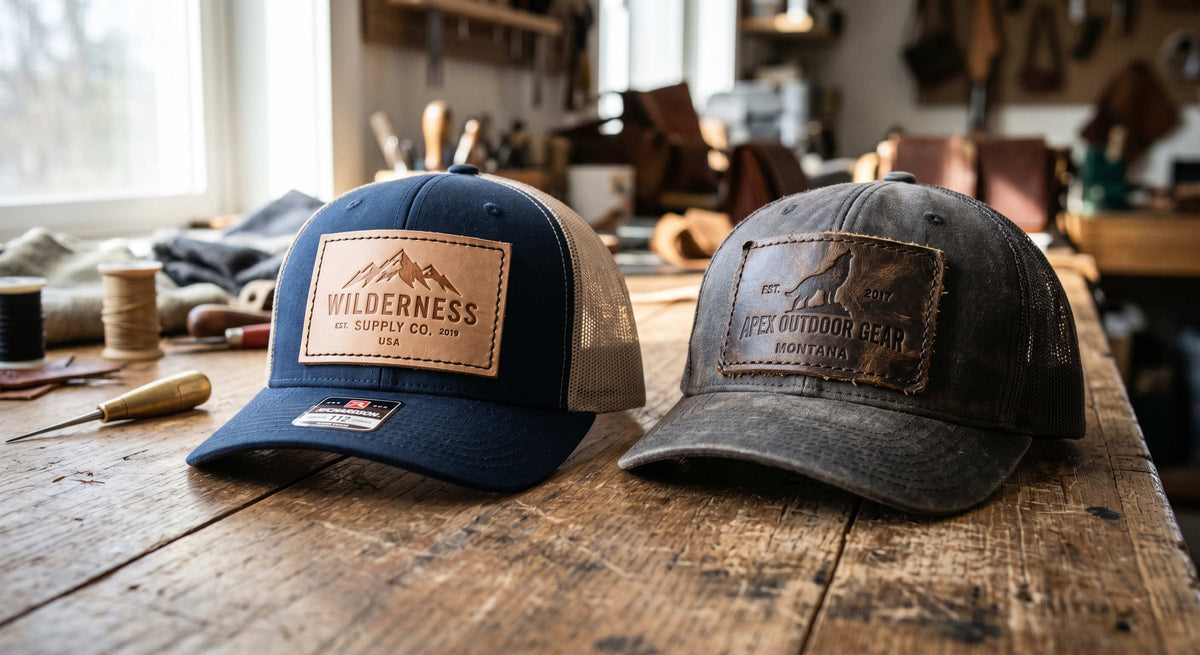
A leather patch hat is a cap with a piece of genuine or faux leather sewn to it. Your logo is pressed or burned into the leather. The patch is made first, then hand-stitched to the hat with thread around its edge. Nothing is glued and nothing is ironed on. On a hat, the patch can go on the front, the back, or either side.
Leather is one of five patch types we make, alongside PVC, woven, sublimated, and embroidered patches. Our patch hats guide compares all five by logo, look, and wear. This article stays on leather: the material, the two finishes, the hat styles that carry it well, and how it ages.
The most common leather patch hat is a structured trucker with the patch on the front, and that is where the look reads best. If that is already your hat, browse custom patch hats and open any product page to see your logo on it.
Genuine vs. Faux Leather: How to Tell Them Apart

Genuine leather is real animal hide, tanned and cut to shape. Faux leather is a man-made sheet, usually polyurethane over a fabric backing, made to look like hide. Both take a deboss or a laser engraving, and both are hand-stitched to the hat the same way. The difference shows up over time, and it is easy to miss in a product photo.
Five things give the material away before you approve a proof, or when a hat lands on your desk:
- Grain pattern. Real hide has an uneven surface; the pores vary in size and the grain drifts in direction. Faux leather repeats the same pattern at regular intervals because it was pressed from a template.
- Cut edge. A cut edge on genuine leather shows a fibrous core. A cut edge on faux shows a thin coating over a cloth-like layer.
- Pores. Genuine leather has pores scattered at random across the face. Faux has none, or one set that repeats.
- Weight and thickness. A genuine patch feels heavier than a faux patch of the same size. A photo shot at an angle shows the thickness.
- Light and smell. Genuine leather scatters light unevenly, with small highlight shifts across the face. Faux reflects more evenly and can carry a slight plastic sheen. In hand, genuine leather smells like leather and faux does not.
Aging is the real divide. Genuine leather darkens where fingers touch it, most of all along the top edge above the bill. The whole face slowly builds a patina. Faux leather holds its color and texture through normal wear. Under hard sun it goes pale and stiff. Water behaves differently too: faux wipes dry, while genuine leather absorbs a splash and needs to air-dry.
Pick genuine leather when you want the hat to look better in year three than on day one. Pick faux when every hat in a run has to match and stay matched, or when you want the leather look without animal hide.
| Leather | What it is | Surface | How it ages | Water | Best for |
|---|---|---|---|---|---|
| Genuine | Real hide, tanned and cut | Uneven grain, random pores, natural tone | Darkens and softens; builds a patina | Absorbs, then air-dries | Heritage, ranch, bourbon, trades, hats meant to be kept |
| Faux | Polyurethane over a fabric backing | Even, repeating pattern, slight sheen | Holds its first look, then goes pale or stiff | Wipes dry | Uniform runs, event hats, buyers avoiding hide |
Grade Words You Will Meet on Other Sites
Other sellers label their leather with grade names, and the words are confusing. Full-grain is the top layer of the hide with its natural surface left intact. Top-grain has that surface sanded and refinished for a more even look. "Genuine leather," used as a grade, means a lower layer of the hide. On our site, and on most hat sites, it means real leather as opposed to faux. Bonded leather is shredded scrap pressed together with a binder, and it does not age like hide.
Debossed vs. Laser Engraved: Which Finish Fits Your Logo?

We finish leather patches two ways: debossed or laser engraved. Debossing presses the design into the leather, so the logo sits recessed and reads slightly darker than the face around it. A colored deboss adds a color fill inside the pressed area, matched to the Pantone you specify. Laser engraving burns the design into the surface, which leaves a darker tone with no depth and holds finer lines than a press can.
Deboss is the classic leather patch look: a wordmark, a monogram, a shield, a simple icon. It rewards bold shapes and loses thin strokes, because a pressed line needs enough width to hold its edge. Laser engraving keeps thin serifs, small secondary text, and interior line detail that a press would soften. It reads a little flatter and more graphic than a deboss, and there is no raised or recessed feel under the thumb.
| Finish | How it is made | Look | Holds | Best for |
|---|---|---|---|---|
| Debossed | Design pressed into the leather | Recessed, slightly darker edges, tactile | Bold shapes and medium lines | Wordmarks, monograms, shields, simple icons |
| Colored deboss | Pressed, then color filled in the recess | Recessed with a Pantone-matched color | Bold shapes with one clear fill area | A brand color that has to show on the patch |
| Laser engraved | Design burned into the surface | Darker tone, flat, crisp edges | Thin lines, small text, interior detail | Fine wordmarks, line art, logos with a tagline |
If your logo is a one-color wordmark or icon, choose deboss. If it carries thin strokes, a small tagline, or interior detail, choose laser engraving. If a brand color has to appear on the patch, choose a colored deboss. A logo that needs several colors or a gradient belongs on a sublimated patch. A logo with fine lettering belongs on a woven patch. Leather is for bold marks. Our leather patch hat ideas pair fifteen designs with the finish that suits each one.
We do not emboss leather (raise the design above the surface) and we do not print on it. If a line in your artwork is too thin for the press, it shows on the design proof we send before production. We then suggest laser engraving or a heavier stroke.
How Long Does a Leather Patch Hat Last?

A hand-stitched leather patch stays on for the life of the hat. Thread around the edge does not lift, peel, or let go in the wash the way a glued or ironed-on patch can. What changes over time is the leather itself, and how it changes depends on where the hat lives.
Genuine leather wears in. Daily use darkens the face and softens the patch, and the sewn edge stays crisp. Faux leather wears out. It keeps its look for a long stretch, and when it goes it turns pale, stiff, or cracked at the edges. How fast either happens depends on the hat's life; a dashboard hat and a closet hat age at different speeds.
Five things damage a leather patch:
- Prolonged direct sun. Dashboards, sunny ledges, and all-day outdoor wear in a high-sun climate all do it. Genuine leather fades unevenly; faux goes pale and stiff.
- Salt. Sea spray and dried sweat pull the moisture out of leather. Left alone, the edges crack.
- High heat. A hat cooking on a dashboard in summer shrinks and stiffens leather.
- Abrasion. A hat tossed in a toolbox, pocketed with keys, or riding loose in a truck bed gets scuffed. Scuffs across the grain do not buff out.
- Harsh cleaners. Bleach, ammonia, and solvents strip the finish and stain leather in blotches.
Patina and damage look different. Even darkening, lighter high points where the patch gets touched, and a softer feel are signs of a genuine patch aging well. Cracking, stiffness, patchy bleaching, and brittle edges are damage, and nearly always trace back to one of the five causes above.
Which Hat Styles Take a Leather Patch Best?

Leather looks best on a hat with a flat, structured front panel, because the patch lies flat and its sewn edge stays even. It works on most other styles too, with a different read on each.
Structured truckers and 5-panel caps. These are the natural home for leather. The Richardson 112 is one of our best sellers by quantity. It has a 60/40 cotton and polyester twill front, a polyester mesh back, a structured six-panel crown, a pre-curved bill, and a snapback. Its five-panel version, the 112FP, has no center seam on the front, so a wide patch sits on one clean surface. Browse custom trucker hats for the full range.
Rope hats. Leather and a rope brim are a heritage pairing that reads Western or outdoor before the logo registers. Bourbon, ranch, and real estate brands use it for that reason. Our vintage rope hats post covers the corduroy and earth-tone styles that pair with it.
Dad hats. The unstructured front curves under the patch, so the edges read softer than on a structured cap. It suits lifestyle brands that want a relaxed look.
7-panel caps. A 7-panel cap has a rounder, taller crown with a one-piece front. Leather looks expensive here, which suits upmarket lifestyle brands.
Snapbacks and flat bills. Both caps carry a leather patch well. On a flat-bill streetwear cap the leather reads heavier, and that contrast can be the point.
Beanies. We hand-stitch the patch through the knit on the cuff, like every other patch we make. A simple shape, a circle or a rectangle, sits flattest on knit.
Performance caps. Leather reads out of place on moisture-wicking fabric. PVC is the usual choice there.
How Big Can the Patch Be, and Where Does It Go?
A leather patch goes on the front, the back, or either side of a hat, and each placement has a size limit in inches. The front panel takes a patch up to 6 inches wide by 3 inches tall, starting half an inch above the bill seam. The back, above the closure, takes 4 by 2 inches. Each side takes 3 by 2. On a beanie, every placement is 4 by 2.3 inches, centered on the cuff.
| Placement | Largest leather patch (width by height) |
|---|---|
| Front of a structured cap | 6 by 3 inches |
| Back, above the closure | 4 by 2 inches |
| Left or right side | 3 by 2 inches |
| Beanie cuff, any placement | 4 by 2.3 inches |
Most front patches sit well inside that box; a patch that fills the panel edge to edge looks crowded. The exact size and shape are set on your design proof, so you see the patch at scale on the hat before anything is made. A front patch also pairs with embroidery on the sides or back. A leather logo up front and stitched initials on the side can share one hat.
How Do You Clean a Hat with a Leather Patch?

Cleaning a cap with a leather patch comes down to keeping water, heat, and chemicals off the patch. It takes less work than a leather jacket or a pair of boots, but it is not zero.
Cleaning. Wipe the patch with a damp cloth along the grain. If the cap needs a wash, hand-wash it in cool water with a mild detergent. Keep the patch out of the water as much as you can. No washing machine and no dryer; the heat does more harm to the leather than the water does.
Sweat. Wipe the patch down after a hard day in the sun. Dried salt is what cracks the edges.
Conditioning. A genuine patch takes a light coat of neutral leather conditioner a few times a year. Rub it in with a cloth and wipe it off after a minute. Skip petroleum-based dressings, which darken leather unevenly and leave residue. Skip conditioner on faux leather altogether; it will not absorb it.
Sun. Keep the hat off the dashboard and the sunny windowsill between wears.
If it gets soaked. Let it air-dry away from heat, with no hair dryer and no radiator. Once a genuine patch is fully dry, condition it to put back the moisture the water pulled out.
How to Order a Leather Patch Hat
Every leather patch hat we sell is ordered the same way. Open a hat's product page, click "Start designing," and pick Patch as the customization method in the Design Studio. Choose Leather, then genuine or faux, then debossed or laser engraved, then standard or colored. Upload your logo or build one from text and shapes, and you see it on the hat before you add it to the cart.
After you order, we send a design proof within 1 to 2 business days, with unlimited revisions before anything is made. Standard production for patch hats is 4 to 6 weeks from proof approval. Rush is available on request: contact us by phone, email, or live chat before you order, and we confirm what is possible for your date. There is no artwork fee and no setup fee, and U.S. shipping is free.
There is no minimum. One hat is a real order, and ordering one is how to check a design before a larger run. A single patch hat costs more per unit than the same hat in a run, because patch setup and tooling are expensive at low volume. One-unit orders are not refundable. We make custom hats and apparel in-house in Greensboro, North Carolina, and custom bags are coming.
Frequently Asked Questions About Leather Patch Hats
How can I tell if a leather patch hat is genuine or faux?
Look at the grain, the cut edge, the pores, the thickness, and the way the surface catches light. Genuine leather is uneven, fibrous at the edge, and scatters light; faux repeats one pattern, shows a coating at the edge, and reflects evenly. In hand, genuine leather smells like leather.
Will a leather patch hat fade in the sun?
Under normal wear, genuine leather darkens rather than fades. Prolonged direct sun on a dashboard or a sunny ledge fades it unevenly and dries it out. Faux leather goes pale and stiff under the same exposure. Store the hat out of direct light between wears.
Can you wash a cap with a leather patch on it?
Spot clean the patch with a damp cloth. If the fabric needs it, hand-wash the cap in cool water with a mild detergent and keep the patch as dry as you can. Never use a washing machine, a dryer, or a harsh cleaner. Washing does not loosen the patch, because it is sewn on, but heat and chemicals harm the leather.
Can a leather patch hat get wet?
Yes. Rain and a wet-day splash do no lasting harm. Faux leather wipes dry; genuine leather absorbs some water and needs to air-dry away from heat. Repeated soaking without conditioning is what dries genuine leather out and cracks the edges, so condition it once it is dry.
Can I add embroidery next to the leather patch?
Yes. A leather patch on the front pairs with embroidery on the sides or the back of the same hat. A logo up front and a name or a year stitched on the side is a common combination. Each placement is chosen in the Design Studio and shown on your proof.
Does the leather patch outlast the hat?
The sewn patch stays attached for the life of the hat, so the hat body usually gives out first. Genuine leather stays presentable through years of normal wear and gains character as it goes. Faux leather keeps its first look and then wears out. Sun, salt, heat, abrasion, and harsh cleaners shorten either one.
Pick Your Leather and Your Finish
Genuine or faux decides how the hat ages. Debossed or laser engraved decides how much detail the logo keeps. Settle those two, put the patch on a structured front panel, and keep it off the dashboard.
When you are ready, design your leather patch hat on any hat in the collection. You see the patch on the hat before you order and a proof before we make it. Questions about an order? Contact us by phone, email, or live chat.
Share:
What Is a 7-Panel Hat? One-Piece Front, 7 vs 6 vs 5 Panel
Woven Patch Hats: Small Logos and Thin Lettering Stay Sharp