

Key Takeaways
- The Imperial 5054 is the course default: structured, mid-profile, performance fabric, a moisture-management sweatband, and a contrast rope.
- Leather patch suits the hats a pro shop sells; flat embroidery suits staff hats and tournament fields.
- For a March opening, order patch hats in early January and embroidered hats by late January.
- Golfers are split on the rope itself, so pair the rope hat with a plain performance cap.
A golfer on a golf forum spent two hours driving between shops for one hat. They wanted a mid-profile performance hat with a rope across the bill and a snapback, wearable off the course. The advice they got was to find the Imperial body first and then a course that stocks it with its own logo. That is the order this guide covers, from the side of the course, the pro shop, or the tournament placing it.
Rope hats in golf come down to three decisions. Which hat carries the logo, which customization method puts it there, and when the order goes in so the hats arrive by opening day. Each section below settles one of them, with the hat facts taken from the maker's spec sheets.
Table of Contents
- Why Golf Buyers Choose Rope Hats
- Who Orders Golf Rope Hats, and What Each Program Needs
- Which Rope Hat Fits Your Course?
- Leather Patch or Embroidery for a Course Logo?
- When to Order Golf Rope Hats for the Season
- Frequently Asked Questions About Golf Rope Hats
- Put the Course on the Hat
Why Golf Buyers Choose Rope Hats
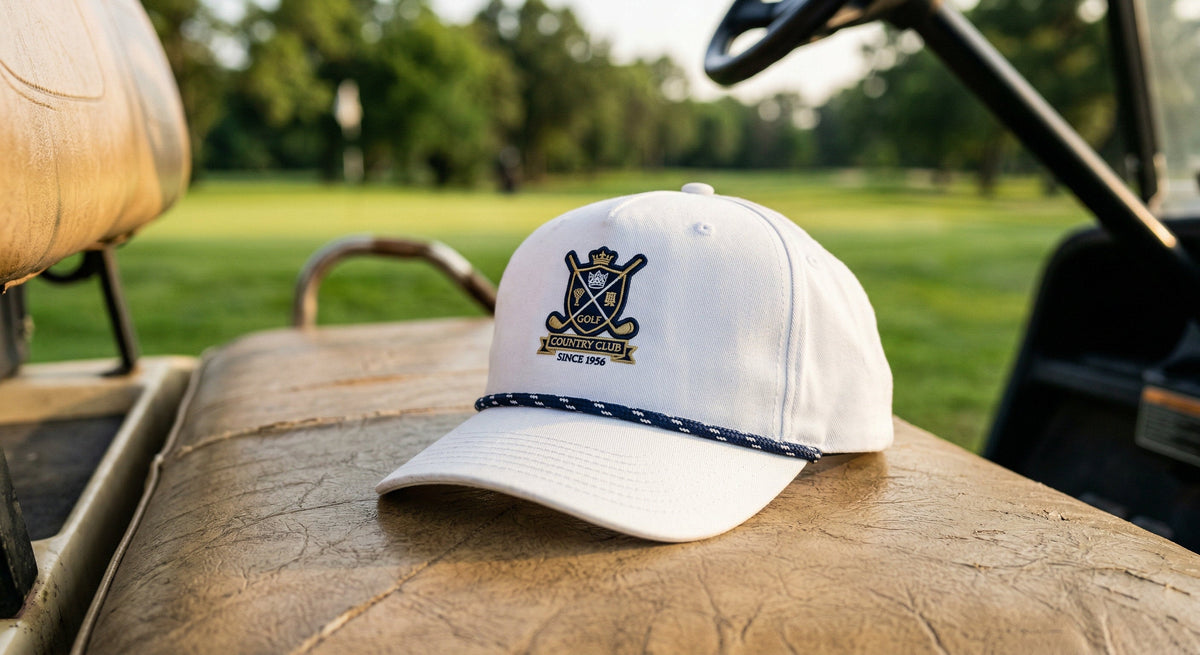
A rope hat is a structured cap with a braided cord stitched along the seam where the front panel meets the bill. The cord does nothing for fit. It is there for the look, and in golf that look carries weight for three reasons.

It reads as golf. Golfers on forums place the rope hat in the 1970s to 1990s, the cap their grandfather played in, and that memory is the point. A rope hat with a course logo looks like it has always been the course's hat. Our rope hat guide covers the construction and the history in full.
It passes the dress code. A flat-bill snapback reads as streetwear at most private clubs. A bucket hat reads as too casual for a member event. A rope hat sits between them, structured enough for the clubhouse and distinctive enough to be worth buying.
The equipment brands sell it. TaylorMade, Titleist, and Callaway each carry rope hats in their own lines. Golf lifestyle brands like Good Good Golf, Bad Birdie, and Malbon each run a rope hat collection. A golfer who already owns one of those hats sees a course version on the same kind of body as an easy second purchase.
One honest caution from the same forums: the rope divides golfers. One thread opened with "the rope serves zero functional purpose" and drew replies from golfers who wear nothing else. A program that offers only rope hats leaves the first group with nothing to buy. That is why the hat comparison below ends with a plain performance cap. If you already know the look, browse custom rope hats and open any product page to see your logo on the hat.
Who Orders Golf Rope Hats, and What Each Program Needs
Four kinds of buyers order golf rope hats: golf courses, pro shops, tournament organizers, and independent golf brands. Each one measures success differently, so the right hat and method differ too.
Golf courses: staff, members, and events
A course runs up to three hat programs, and they are not the same order. Staff hats go on the pro shop team, starters, and bag staff for a season of daily wear. Consistency on a reorder matters more than finish there. Member hats are retail. They sit next to the equipment-brand hats and have to look like something a member would choose over them. Event hats go to every player at a member-guest or charity round, so the cost per hat sets the method.
Most courses cover those three jobs with two hats. A leather patch rope hat goes on the shelf, and a flat-embroidered version of the same hat goes to staff and events.
Pro shops

A pro shop treats the rope hat as inventory: which colors, how many, and when to reorder. The colors that move are the classic course palette. White or natural with a contrast rope, and navy or black with a tonal rope, cover most shelves.
Golfers on forums complain about pro shop hat prices and about expensive pieces with a mark too small to read. A course logo sized to the front panel, in one or two colors, is what they say they buy. There is no minimum on any customization method, so a mid-season reorder of a dozen hats in the sold-out color is a real order.
Tournament organizers
A tournament has one constraint that outranks everything else: the date. The hats have to be on the registration table, so the order is planned backward from that day. The method choice comes first, because it sets the production window. A leather patch rope hat with the event name and year is a keepsake players wear after the round. Flat embroidery is the choice for a large field on a fixed budget.
Quantity follows the registration list: one per player, plus staff and volunteers. Our golf tournament gifts guide covers that math and what golfers say about tournament hats.
Independent golf brands and course co-branding

Golfers search for TaylorMade and Callaway rope hats because they see them on tour. A course hat answers a different want. Forum threads about small golf brands run long, and the same golfers say they are tired of seeing the two biggest brands everywhere. A rope hat with the course crest, or a small brand's own mark, says where someone plays rather than what they bought.
Which Rope Hat Fits Your Course?

Crown height is the fit complaint golfers raise most. One forum buyer put it this way: "some claim to be mid-profile but they must be measuring a gorilla". The four hats below are listed with the maker's own spec lines, so the profile you read is the profile you get. All four are five-panel snapbacks with a rope braid.
| Hat | Fabric | Structure and profile | Bill and sweatband | Best for |
|---|---|---|---|---|
| Imperial 5054 The Wrightson Cap | 100% recycled polyester performance fabric | Structured, mid-profile | Pre-curved bill; moisture-management, antimicrobial sweatband | The course default: member retail, staff, and events |
| Richardson 258 Five-Panel Classic Rope Cap | 100% polyester performance | Structured, mid-profile | Pre-curved bill, grey undervisor; Stay Dri sweatband | Courses and brands that also sell to outdoor and fishing buyers |
| Imperial 5055 The Rabble Rouser Cap | Recycled polyester front, polyester mesh back | Structured, mid-profile | Pre-curved bill; moisture-management, antimicrobial sweatband | Hot-climate courses that want the rope look with airflow |
| Legacy CHILL The Chill Cap | 100% nylon | Unstructured, low-profile | Flat bill | A relaxed, lifestyle-forward hat for a younger membership |
The Wrightson is the hat the forum buyer above was describing: mid-profile, performance fabric, a sweatband made to manage sweat, a rope, and a snapback. Its structured front holds a logo flat, so embroidery sits without pulling and a leather patch lies flush. The 258 is close to it on paper. It differs in details an outdoor or fishing crowd notices: the grey undervisor and the Stay Dri band. The 5055 keeps the Wrightson front and swaps the back panels for mesh. The Chill Cap is a different hat altogether: soft, low, flat-billed, and closer to what the lifestyle golf brands sell.
Rope color decides the first impression from across the fairway. White rope on navy or black reads country club. Tan or wheat rope on natural or cream reads outdoors and craft. A white rope on a white hat disappears, so pair a light hat with a navy or royal cord.
For the golfers who do not want a rope at all, add a plain performance cap in the same colors with the same logo. It gives the anti-rope member something to buy and keeps the staff program on one look. You can browse custom hats for the performance styles we carry.
Leather Patch or Embroidery for a Course Logo?
Two customization methods handle most course logos: leather patch and flat embroidery. The right one depends on what the hat is for, and the table settles it.
| Method | How it looks | Best for | Standard production |
|---|---|---|---|
| Leather patch | Logo debossed or laser engraved into genuine or faux leather, hand-stitched on | Member retail, tournament keepsakes | 4 to 6 weeks from proof approval |
| Flat embroidery | Thread stitched into the front panel | Staff hats, large event fields | 2 to 3 weeks from proof approval |
| 3D puff embroidery | Raised thread over a foam base | Block-letter course names and thick wordmarks | 2 to 3 weeks from proof approval |
Leather patch is the retail choice. The logo is pressed or engraved into the leather, the patch is cut to shape, and we hand-stitch it to the front panel. A member picks it up and feels a product rather than a giveaway, which is what puts it on the shelf beside the equipment-brand hats. Genuine or faux leather is your call, and a colored deboss adds a fill color to the pressed logo.

Flat embroidery is the volume choice. Thread stitched into the panel handles a season of sweat and washing, and it costs less per hat than a patch. A 72-player field or a staff of twenty gets the same logo without the patch step. 3D puff embroidery raises the thread over foam and suits a course name in block letters. It is less common in golf than flat stitching, and it is the right pick for a brand with a bold, graphic mark.
Size the logo to the hat, not the file. On these caps a front design runs up to 6 by 2.3 inches in embroidery, or 6 by 3 inches as a patch. Each side panel takes a design up to 3 by 2 inches. That is where a tournament year or a sponsor mark goes when the course logo owns the front. Keep the side mark to a single line or a small crest; at that size, fine detail closes up.
When to Order Golf Rope Hats for the Season

The most common ordering mistake in a golf program is counting forward from the day the order goes in. Count backward from the day the hats have to be in hand, and start from these windows.
| Step | How long it takes |
|---|---|
| Design proof after you order | 1 to 2 business days |
| Patch methods, standard production | 4 to 6 weeks from proof approval |
| Embroidery and printing, standard production | 2 to 3 weeks from proof approval |
| Shipping | Ground service with free U.S. shipping; the checkout shows the delivery estimate |
For a course that opens March 1, a leather patch order goes in the first week of January. A flat embroidery order goes in by the last week of January. A tournament works the same way from its event date. Nothing is made until you approve the proof, so every round of changes adds time before production starts. A staff program with several color options needs an extra week of buffer.
Rush is available on request for every method. Before you order, call, email, or open live chat with your in-hand date, and we will say what is possible.
Ordering runs from any product page. Open the hat, click Start designing, choose the side and the method, and upload the course logo as a PNG or JPEG. Any other file type can be emailed to custom@griwolfe.com and we bring it in. The Design Studio shows the logo on the hat itself before you add it to the cart. We make custom hats and apparel in-house in the USA, with bags coming. A course that wants staff polos to match the hats can order both in one place.
Frequently Asked Questions About Golf Rope Hats
How far ahead should a golf course order rope hats for spring?
Count back from opening day: about eight weeks for a patch method and about five weeks for embroidery. For a March 1 opening, that means early January for a leather patch order and late January for flat embroidery. Those windows cover the 1 to 2 business day proof, standard production, and ground shipping. If the calendar is already tighter, contact us with the date before ordering and ask about rush.
What rope color works best on a white or cream golf hat?
Navy or royal blue rope on white gives the classic country club look. Tan or wheat rope on natural or cream reads outdoors and heritage. Avoid white rope on a white hat, because the cord vanishes against the fabric and the hat loses the detail it was chosen for. Some courses run two colors with different cords so members have a second option mid-season.
Can a golf rope hat carry the course logo and a sponsor logo?
Yes. The front and each side panel are designed on their own. The usual layout puts the course logo on the front and the tournament year or sponsor mark on one side. A side design runs up to 3 by 2 inches, so keep it to one line of text or a small crest.
Do all golfers like rope hats?
No. Golfers on forums are split; some wear nothing else and some call the rope useless. A course program should not depend on everyone liking it. Offer the rope hat as the retail piece and pair it with a plain performance cap in the same colors. The golfer who wants no rope still buys a course hat.
Can a pro shop reorder a small quantity mid-season?
Yes. There is no minimum on any customization method, so a reorder of any size is a real order. One color can be reordered on its own. Reorders follow the same proof and production windows as the first run, so place them as soon as a color starts to run low.
Can I check the hat before ordering a full pro shop run?
Two ways. An undecorated sample hat is available on request for a small fee plus shipping; call or message us to arrange one. To check the finished custom hat, order one unit, since there is no minimum. A one-unit patch order costs more per hat than a run and is not eligible for a refund.
Put the Course on the Hat
Pick the hat by the program. The Imperial 5054 suits most courses, the 258 an outdoor crossover, the 5055 a hot climate, and the Chill Cap a relaxed brand. Pick the method by the job: leather patch for the shelf, flat embroidery for staff and fields. Then count back from opening day. When you are ready, design custom rope hats on any product page and see the course logo on the hat before you order.
Questions about a program or a date? Phone, email, and live chat are staffed full time.
Share:
How to Order Custom Patch Hats: Sizes in Inches, No Minimum
How to Design Your Own Hat Online (Free, No Minimum)