

Key Takeaways
- A rope hat reads vintage through fabric, color, crown, and finish; the rope itself is on modern hats too.
- Corduroy is the strongest signal, washed cotton is second, and performance fabric reads modern.
- Five hats we carry fit the look: two corduroy (Richardson 253 and 930) and three cotton (Locale WILSON, Legacy SKULLY, Imperial 5056).
- Leather patch is the strongest heritage pairing; there is no minimum on any method, so one hat is a real first order.
A rope hat looks vintage because of four choices: the fabric, the color, how the crown holds its shape, and the finish on the cloth. The rope is not one of them. Every rope hat has the cord, including the bright white performance caps golf brands sell today. So the cord cannot be what makes a hat read old.
Below are the four cues, who orders these hats and why, five hats we carry for the look, and the method that finishes it. The hat facts come from the makers' spec sheets. The buyer evidence comes from the brands already selling these hats and the people collecting them.
Table of Contents
- What Makes a Rope Hat Look Vintage Instead of Modern?
- Who Orders Vintage Rope Hats, and Why?
- Which Colors and Rope Details Signal Vintage?
- Which Rope Hats Are Built for the Vintage Look?
- How the Rope Hat Went from Golf Course to Taproom
- Which Customization Method Fits a Vintage Rope Hat?
- Frequently Asked Questions About Vintage Rope Hats
- Put Your Logo on a Vintage Rope Hat
What Makes a Rope Hat Look Vintage Instead of Modern?

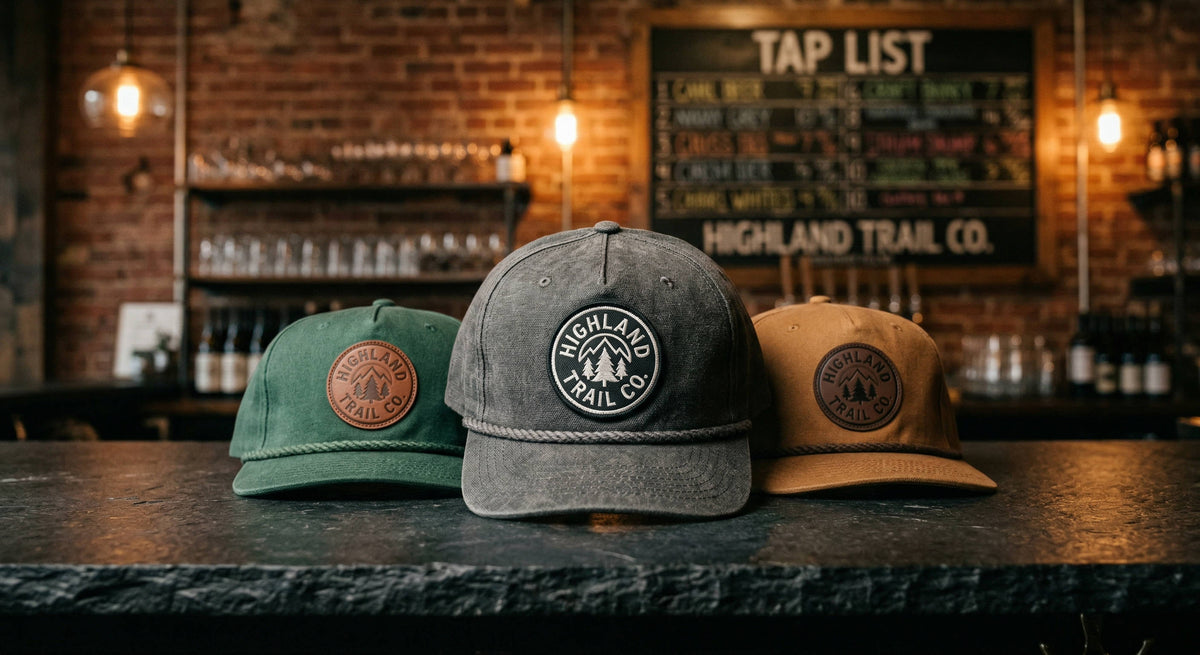
A rope hat reads vintage when the fabric, color, crown, and finish all point to the 1970s through the 1990s. A structured, bright white rope hat with a clean modern logo reads like a golf pro shop. The same shape in brown corduroy with a leather patch reads like a taproom wall. Four choices make the difference.
Fabric. Corduroy is the strongest vintage signal in the rope hat category. The ridges catch light the way flat cloth cannot, and the texture alone places the hat in an earlier decade. Cotton twill with a washed finish runs second; the soft feel and slightly faded color suggest the hat has been around longer than it has. Performance polyester reads modern and athletic no matter what sits on the front.
Color. Earth tones define the palette: brick red, forest green, wheat, burnt orange, slate, brown, and natural. Those colors come out of outdoor and workwear traditions. Bright white, neon, and high-contrast color blocking belong to the modern rope hat.
Crown. A soft crown, meaning a front panel with no stiffener inside it, sits lower and settles onto the head, with no rigid dome. That relaxed, broken-in profile is the shape people have in mind when they call a five-panel rope cap a grandpa hat. On an r/hats thread asking what the rope-at-the-brim style is called, the one answer was that they are sometimes called grandpa hats. A structured front still works for a vintage look; it leans on fabric and color to carry the signal.
Finish. A washed cotton comes out of the box looking worn in. So does a pigment-dyed one, where the color sits on the surface of the fiber and softens with washing. That is the difference between fresh off the machine and a season on the shelf at the general store. Among the rope hats we carry, the Legacy SKULLY is the one built on pigment-dyed cotton. The two Richardson corduroy caps get their character from the corduroy itself.
If you already know the look you want, browse custom rope hats and open any product page to see your logo on the hat. The rest of this guide is for choosing well before you do.
Who Orders Vintage Rope Hats, and Why?

Four kinds of brands order vintage rope hats: craft breweries, western and country brands, outdoor and hunting brands, and local shops. All four want merchandise that signals craft and a sense of place. A search for "vintage rope hats" in September 2026 returns almost no articles. It returns a diner chain's retro rope hat, a cidery's, a boat-supply company's, a sweet-tea chain's, and a hunting brand's. Each sells one hat with its own mark on it, and your brand would be joining that group.
Craft breweries. Breweries were early adopters, and the pattern holds in 2026. Narragansett sells a 60's Retro Rope Hat and a 'Gansett Rope Hat alongside two newer rope styles. Boulevard Brewing sells a Sandlot Vintage Rope Hat. Tree House Brewing carries several rope hats, including a vintage-logo version. Burial Beer sells a Retro Logo Rope Five Panel Hat, and Pfeiffer's sells a Classic Rope Hat in navy with a red rope. A trucker hat says distributed product. A vintage rope hat says made here, which is the claim a taproom is built on.
Western and country brands. Country music's mainstream run since 2022 created demand for western-adjacent merchandise that is not a full cowboy hat, and the rope cap fills that gap. Lazy J Ranch Wear runs a rope hat collection of dozens of designs under a "born and raised on Texas ranching" banner. The hats that sell in this lane carry leather patches on earth-tone bodies and reference heritage without a brim and band.
Outdoor and hunting brands. Huck Outdoors runs its rope hats as a Backroads Edition line. YoColorado markets its rope collection for a mountain hike and the brewery stop after it. Canvasback Waterfowl sells a mid-crown cotton rope hat as its everyday lid, and American Flyway Waterfowl pairs camo bodies with leather patches. These brands need a hat that says "we spend time outside" without looking like athletic gear. A small outfitter ordering its first branded hats faces the same choice. A rope cap in earth tones with a leather or woven patch settles it.
A guide service or waterfowl lodge that needs camo instead of earth tones is a different order. Our fishing rope hat guide covers the seven camo prints on the Richardson 256P and which patch holds a fish logo.
Coffee shops, grocers, and local retailers. Smaller operations choose this style for the same reason breweries do: it signals authenticity at any order size, and customers want to own it. A Charleston subreddit thread asked for favorite local hats. The answers named rope hats from a corner grocery, a marina store's hat, and a surf shop's. One restaurant had recently rebranded, and a reply called its old hat "a collectors item now". One reply came from a bar in Boston, from someone wearing a Charleston trucker hat. People seek out hats from small businesses and wear them far from home, which is more advertising than any giveaway earns.
Which Colors and Rope Details Signal Vintage?
The vintage read comes from pairing an earth-tone body with a rope that either blends in or contrasts on purpose. The wrong pairing turns the same hat modern.
Corduroy pairings. Corduroy in brick red, forest green, brown, or camel with a matching or natural rope is the strongest vintage combination. For a bolder version, pair dark corduroy in brown or olive with a cream or natural rope so the cord reads from across a room.
Cotton pairings. Washed cotton in wheat, slate, olive, or faded navy with a tan or white rope reads outdoor heritage. This is the palette for fly-fishing brands, farm operations, and mountain-town retail. Stark white cotton reads too clean for the look.
Rope color. A rope that matches the body, such as forest green on forest green, gives a tonal look where the cord is present but quiet. A contrasting rope, white on navy or tan on olive, makes the cord the accent. Both work; the contrast version reads louder and more deliberately retro. Two-tone bodies with a contrasting front panel sell for the same reason. A two-tone rope cap pushes toward the modern side, though, so keep both tones muted.
What breaks the look. Neon rope, metallic thread, bright white structured panels, and a performance mesh body all pull the hat toward athletic wear. If the hat could pass on a driving range, it is not reading vintage.
Which Rope Hats Are Built for the Vintage Look?

Five rope hats we carry are built for the vintage look: two in corduroy and three in cotton. The table lists each one with the maker's own spec lines, so the fabric and crown you read are the ones you get. Every hat here has a snapback closure.
| Hat | Fabric | Crown and profile | Bill and rope | Fits |
|---|---|---|---|---|
| Richardson 253 Timberline Corduroy Cap | 100% cotton corduroy, fully lined with lightweight cotton | Structured, six-panel, high profile | Flat bill, thin rope braid, UPF 50+ | 7 to 7 3/4 |
| Richardson 930 Troutdale Corduroy Trucker Cap | 100% cotton heavyweight corduroy front, soft polyester mesh back, cotton lined | Soft structured, five-panel, low profile | Pre-curved bill, thin rope braid | 7 to 7 3/4 |
| Locale WILSON Unstructured with Rope Cap | 100% cotton | Unstructured, five-panel, low profile, mesh liner behind the front | Flat bill made from recycled plastic, wide rope braid | 6 3/4 to 7 1/2 |
| Legacy SKULLY Skully Cap | 100% pigment-dyed cotton | Unstructured, five-panel, mid profile, mesh liner behind the front | Slightly curved bill, rope braid | 6 5/8 to 7 3/8 |
| Imperial 5056 The Barnes Cap | 100% lightweight cotton twill | Structured, five-panel, mid profile, retro fit | Pre-curved bill, woven rope braid | 6 5/8 to 7 3/8 |
The 253 Timberline is the benchmark for the corduroy rope hat. It is a structured six-panel with a high crown, so the vintage read comes from the corduroy and the color alone. It is also fully lined with lightweight cotton. Put a debossed leather patch on it and it reads heritage brand from across the room.
The 930 Troutdale is the same corduroy idea on a trucker frame: a heavyweight corduroy front, a soft mesh back, and a low, soft-structured crown. It is the corduroy option for a brand whose customers wear the hat in July, since the 253 has no mesh back. The rope on both Richardsons is a thin braid.
The WILSON is the broken-in-on-day-one hat. Unstructured, low, and all cotton, with a wide rope across the bill, it has the relaxed shape a structured cap cannot copy. It fits smaller heads than the Richardsons, starting at 6 3/4. Woven patches and flat embroidery in muted thread suit it.
The SKULLY carries the washed-finish cue: pigment-dyed cotton on a soft five-panel with a mid crown. Its color arrives already softened, so a wordmark in cream or rust thread looks like it has been there a while.
The 5056 Barnes is the cotton alternative to a performance rope cap. Lightweight cotton twill, a structured five-panel with a mid crown, and a woven rope. In wheat, olive, or navy with a leather or woven patch, it delivers the vintage look. The structured front still holds a detailed logo flat.
How the Rope Hat Went from Golf Course to Taproom
The rope hat was a golf course cap first. It faded through the 2000s and 2010s as snapbacks took over, then returned in the early 2020s on nostalgia and heritage branding. Our guide to rope hats for golf courses and pro shops covers that program on its own. The full timeline, including why the cord was added in the first place, is in our rope hat guide.
What matters for a vintage buyer is that the shape was already established by the time breweries and outdoor brands claimed it. One distinction is worth being honest about. To a collector on r/vintagecaps, a vintage rope hat is an original from the 1970s to 1990s. The thread's examples were Coke and Motorcraft promotional caps, with the foam and brims replaced to keep them wearable. A brand ordering today buys the cues; the age cannot be ordered. Those originals were all promotional hats too, which is worth remembering when you set a design you will reorder for years.
Which Customization Method Fits a Vintage Rope Hat?
The hat sets the foundation and the customization method finishes it. Four methods suit the vintage look, and printing is the exception to note. Every patch we make is hand-stitched to the hat, and there is no minimum on any method, so the first order can be one hat.
| Method | How it reads on a vintage rope hat | Best for | Standard production |
|---|---|---|---|
| Leather patch | Strongest heritage signal; genuine leather changes with wear | Taproom and pro shop retail, outdoor brands | 4 to 6 weeks from proof approval |
| Woven patch | Reads like a woven label from an older garment | Fine text, small type, detailed marks | 4 to 6 weeks from proof approval |
| Flat embroidery | Classic and timeless in earth-tone thread | Wordmarks, staff hats, larger runs | 2 to 3 weeks from proof approval |
| Sublimated patch | Keeps gradients and full color; reads vintage only when the artwork palette does | Illustrated or photographic logos | 4 to 6 weeks from proof approval |
| Printing | Full color pressed into the fabric; the flat, bright look leans modern | Multicolor logos no patch would hold | 2 to 3 weeks from proof approval |
Leather patch. A leather patch on corduroy or washed cotton is the strongest vintage combination. We make them in genuine or faux leather, laser engraved or debossed, with a colored deboss as an option. Genuine leather darkens and softens with handling, which suits a hat that is meant to look older than it is. This is the method breweries and outdoor brands reach for when the hat is going on a retail shelf.

Woven patch. Fine thread woven into a fabric patch holds small type and thin lines that embroidery thread cannot. On a vintage rope hat it reads like the woven label inside an old jacket. Leather carries the stronger heritage signal. Woven is the pick when the logo has fine text or a detailed mark that a leather deboss would lose.
Flat embroidery. Thread stitched flat in forest green, cream, rust, or navy on a vintage body reads clean and timeless. It is the method for staff hats and larger runs, and the quickest of the four at 2 to 3 weeks of standard production.
Sublimated patch. When the artwork has gradients or photographic detail, a sublimated patch keeps every color. The vintage read then depends on the palette: an illustrated trout in browns and greens fits, a neon gradient does not.
Printing. Full color printing presses the design into the fabric, and we offer it on every hat here. Its flat, bright look leans modern, so save it for a multicolor logo that no patch would hold, and keep the palette muted.
Two practical notes apply to every method. A front design runs up to 6 by 3 inches as a patch and 6 by 2.3 inches in embroidery. The design proof we send within 1 to 2 business days of your order confirms the exact size. And whatever the method, keep the colors restrained: earth-tone thread, natural leather, muted patch borders. A neon-saturated logo on a corduroy body is the fastest way to undo everything the hat was chosen for. Ready to match a method to your hat? Browse custom patch hats to compare the patch types side by side.
Frequently Asked Questions About Vintage Rope Hats
Is a custom rope hat vintage or retro?
Strictly speaking, a new custom hat is retro. A collector's vintage rope hat is an original from the 1970s to 1990s, usually a promotional cap. A new hat built with that era's fabric, color, and crown is retro. Brands and shoppers use "vintage" for both, and this guide does too, but a new custom hat is always a retro build.
Does a corduroy rope hat work in warm weather?
Choose the Richardson 930 Troutdale. It keeps the heavyweight corduroy front and adds a soft mesh back, which the 253 Timberline does not have. For the hottest climates, the all-cotton Locale WILSON or Legacy SKULLY skips corduroy altogether and keeps the soft-crown vintage cue.
Which vintage rope hat fits a smaller head?
The Locale WILSON, which adjusts from 6 3/4 to 7 1/2 on its spec sheet. The Legacy SKULLY and Imperial 5056 run 6 5/8 to 7 3/8. The two Richardson corduroy caps start at 7 and run to 7 3/4, so they suit larger heads.
Should the rope match the hat color or contrast with it?
Either works. A matching rope gives a quiet, tonal look where the cord reads as texture more than stripe. A contrasting rope, cream on brown or white on navy, makes the cord the accent and reads more deliberately retro. Pick the contrast when the logo is simple and the tonal rope when the patch is doing the work.
How long does a vintage rope hat order take?
Your design proof arrives within 1 to 2 business days of ordering, with unlimited revisions before you approve it. Standard production is then 4 to 6 weeks for patch methods and 2 to 3 weeks for embroidery and printing, counted from proof approval. Rush is available on request; contact us by phone, email, or live chat with your date before you order.
Can I see a vintage rope hat before ordering for the whole shop?
There are two ways. An undecorated sample hat is available on request for a small fee plus shipping; call or message us to arrange one. To check the finished custom hat, order one unit, since there is no minimum on any method. A one-unit patch order costs more per hat than a run and is not eligible for a refund.
Put Your Logo on a Vintage Rope Hat

Pick the hat by the cue you want to lead with. Corduroy gives the strongest signal (253 or 930). A soft crown gives the broken-in shape (WILSON or SKULLY). Cotton twill on a structured front holds a detailed logo (5056). Pick the method by where the hat is going: leather patch for the shelf, flat embroidery for staff. Then keep the colors in the earth-tone range.
We make custom hats and apparel in-house in the USA, with bags coming. There is no artwork fee and no setup fee, and every U.S. order ships free. When you are ready, design custom rope hats on any product page and see your logo on the hat before you order.
Share:
Design Your Own Hoodie Online, Front and Back (Free)
DTF vs Screen Printing for T-Shirts: Colors, Cost, and Wear