

Key Takeaways
- Your retail shelf and your crew's gear are two different orders.
- Retail sizing is a guess without a roster, so stock the range edges or lose the sale.
- Adjustable hats need no size forecast, which is why they anchor first orders.
- With no minimum, a seasonal design can be tested instead of bought by the case.
Table of Contents
- What Sells on a Taproom Shelf
- How to Size a Retail Apparel Run
- Brewery Hats: The Half of the Shelf With No Size Problem
- Picking a Customization Method for Brewery Merch
- Staff Merch and Shelf Merch Are Two Different Orders
- Making the Shelf Sell
- Testing a Brewery Merch Design Without Buying a Case
- Frequently Asked Questions
- Where to Start
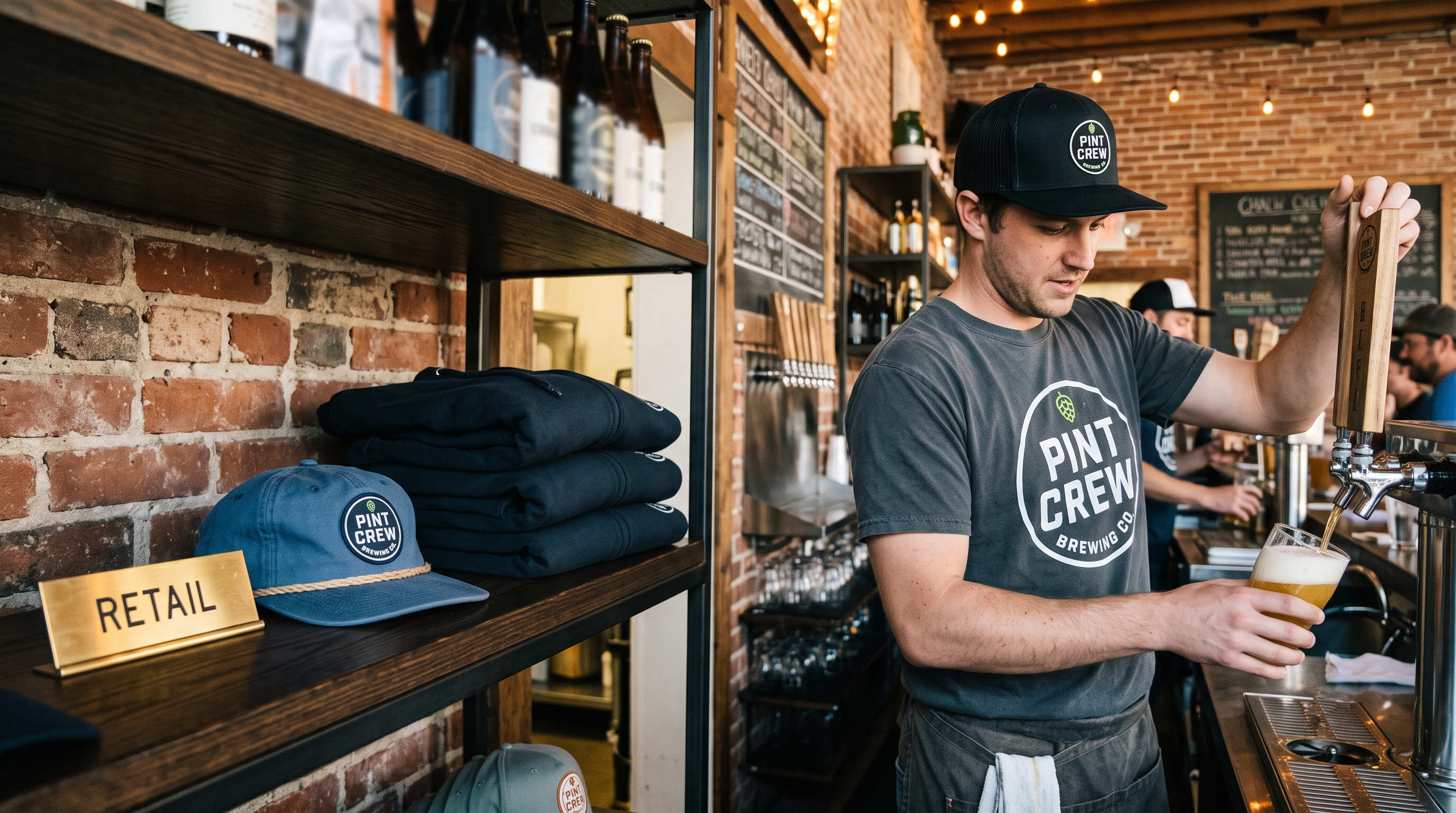
Brewery merch covers two different orders under one name. One is the shelf your customers buy from. The other is what your crew wears behind the bar. They have different buyers, different sizing problems, and different right answers.
This guide covers both. It walks through what to stock, and how to size an apparel run when you cannot poll the people buying it. It also covers which hats work, how to match a customization method to your artwork, and how to lay the shelf out so it sells. The last part is about trying a design without committing to a case of it.
What Sells on a Taproom Shelf
Three products carry most taproom merch sales: a t-shirt, an adjustable hat, and a hooded sweatshirt or crewneck for cold months. Glassware and stickers sell alongside them as low-cost pickups. Start with that core, keep the range narrow, and let the first season tell you what to add.
The reason to start narrow is timing. A small core line sells all year, while seasonal and event pieces have a window. A design tied to a specific date stops selling the day the event ends. Whatever is left is inventory you paid for and cannot move.
Your shelf competes with a lot of other shelves. The Brewers Association counted 9,578 operating US breweries in 2025, with craft taking 24.8% of a $113 billion beer market by dollars. Most of those taprooms sell a logo tee. The ones that sell out are the ones people would wear without the logo.
Once you know what belongs on the shelf, you can browse custom apparel. Your design shows on the actual garment before you order anything.
How to Size a Retail Apparel Run
A size curve is how many of each size you buy. For a crew order you can ask everyone. For a shelf you are buying for people who have not walked in yet, and that guess is where most brewery apparel money gets stranded.
Middle sizes move first almost everywhere, so medium and large carry the deepest counts. The mistake is treating the ends of the range as rounding errors. A customer who wants your shirt and can't find their size doesn't size up. They put it back and buy nothing, and that lost sale never shows up in your numbers.
The gap shows up hardest in women's fit. Unisex cuts are drafted on men's measurements, so a unisex small isn't a women's small. A run stocked only in unisex tells a share of your customers the merch isn't for them. Ladies' cuts exist across tees and polos, and carrying both in the middle sizes costs less than the sales a single-cut run gives up.
The loudest unmet demand sits at the top of the range. Craft-beer buyers looking for a 2XL or 3XL brewery shirt describe racks that stop at XL, or a 2XL cut to wear like an XL. One shopper searching for a shirt for a 6-foot-7 husband went brewery after brewery and found nothing in his size. Buyers in that position remember which breweries stock their size, and they order from those web stores from other states.
There are two traps here. A size label is not a fit, so a 2XL that runs small reads as a brewery that doesn't carry the size at all. Length also fails separately from width, and taller buyers routinely find a 3XL wide enough yet still too short. Neither is solvable by guessing, so order one of a garment and put it on a real person before you commit to a run.
Extended sizes do sell slower per unit than mediums, so stocking them raises your average time to sell through. For most taprooms that cost is worth a sale you would otherwise lose outright. Buy the edges shallow, then reorder what moves.
Sizing is also why you pick the garment before the artwork.
Brewery Hats: The Half of the Shelf With No Size Problem
Hats remove the size curve from that part of the shelf entirely. Most of the caps we carry are adjustable, so one size fits nearly every head. A snapback or strap closure covers the range without any forecasting. Fitted caps are the exception and come in real sizes, which makes them the harder choice for retail.
Hats anchor most first brewery merch orders for exactly that reason. A hat run skips the size distribution entirely, so it is one decision to make and one number to reorder.
The heritage look most craft brands reach for is its own decision. We cover the fabric, color, and structure choices behind it in the guide to vintage rope hats. Truckers, rope caps, and washed twill all sit comfortably in a taproom. The right one depends on how your brand already presents itself.
What matters for the order is the space you have to work with. On a structured cap, a front design runs up to 6 inches wide. Height depends on the method: up to 3 inches for a patch, or up to 2.3 inches for embroidery and printing. A side design runs up to 3 by 2 inches, and a design above the closure opening up to 4 by 2 inches.
A logo can also sit on the front-left or front-right panel, up to 2.75 by 2 inches. That restrained placement often sells better as retail than a full front panel. These are production limits, and your design proof confirms the exact size before anything is made.
To see the shapes on a real cap, design a custom trucker hat. Place your logo on the actual colors you plan to stock.
Picking a Customization Method for Brewery Merch
Match the method to what your artwork is, then check that it fits the space. That order saves the most rework, because artwork is the constraint you cannot change late.
| What your artwork is | Best method | Where it works |
|---|---|---|
| Full color, gradients, or a photographic element | Printing | Full front and full back on apparel; front and side on hats |
| Solid shapes and clean text | Standard flat embroidery | Chest and sleeve on apparel; every hat placement |
| Thick letterforms you want raised | 3D puff embroidery | Hat fronts, where the panel holds the shape |
| Fine text or intricate line art | Woven patch | Hat fronts and chest placements |
| A heritage, tactile look | Leather patch | Hat fronts; cuffs and chest on apparel |
| Unlimited color on a patch shape | Sublimated patch | Hat fronts and chest placements |
Apparel gives you far more room than a cap. A tee takes a chest design up to 4 by 4 inches and a center chest up to 8 by 8. The full front runs to 13 by 17 inches, and a hooded sweatshirt takes 14 by 10.5 there and 14 by 16 on the back. Sleeves run up to 3.5 by 3.5 inches on either garment.
Full front and full back are printing placements, because embroidery and patches top out at 4 by 4 inches on a garment. That ceiling is why large front graphics on brewery apparel get printed. If your design is a big illustrated scene, printing is the only method that carries it at that size.
A cafe and motel in a Wisconsin resort town ordered 72 hooded sweatshirts from us on exactly that logic. The artwork ran full chest in full color, with a second smaller print on the left sleeve, and they'd ordered with us before. That sleeve print is worth copying: it costs little and gives the piece something to notice up close.
All of our patches are hand-stitched, on hats and on apparel. When you are ready to see a design at real scale, shop custom hoodies and try the artwork at full chest before you decide.
Staff Merch and Shelf Merch Are Two Different Orders
The crew order and the shelf order pull in opposite directions on almost every choice.
| Crew order | Shelf order | |
|---|---|---|
| Who you are sizing for | A known roster, so ask | Strangers, so stock a curve |
| What matters most | Durability through repeated washing | Range and browsability |
| Logo scale | Larger reads as staff, which is the point | Restrained sells better as retail |
| Quantity | Headcount plus spares | Your best read on a season |
| Reorder trigger | Wear and turnover | What sells out |
Running one design on both orders is the cheaper path. Items sharing the same design, customization method, size, and placement count together for volume pricing, even across different styles and colors. Move the design to a different placement and that placement prices as its own group.
The placement choice is a real tradeoff. A full front reads as staff at ten feet, and a quieter spot sells better on the shelf. Keep one placement across both orders when the combined count earns a better tier, and split placements once each side carries its own volume.
The last difference is wear. Your crew is in their gear every shift, so it fails on wash cycles long before it fails on style. That is where a heavier garment and embroidery earn their cost.
Making the Shelf Sell
Good merch in a bad spot does not sell. The taprooms that move product treat the shelf as part of the room, and most of what works costs nothing to change.
Where the rack sits does the heaviest lifting. A display near the entrance or the register gets seen coming and going. A back corner reaches only the people already looking for it, so if you change one thing, move the rack.
Prices belong on the merch where a customer can see them. A piece someone has to ask about sells worse than the same piece with a tag, because asking is friction. The same goes for sizes: a range the customer can't see reads as a size that isn't there.
Apparel is bought on feel as much as on artwork, and a folded stack behind glass gives a buyer nothing to go on. Hang one of each design at full size, where the print scale reads from a few feet away.
Your bartenders are in front of every customer all shift, and a hat or hoodie worn behind the bar does more than any sign. It also answers the fit question before it gets asked, which is most of the sale on apparel.
The shelf has an online half too. A brewery's merch audience is larger than the people who can drive over this week, and a simple listing captures the rest. Anniversary releases, festival pieces, and anything tied to a beer people travel for tend to move better online than in the room.
When a design sells out, reorder it while people still want it. Buyers describe wanting a specific brewery cap, finding it sold out, and never seeing it return. That sale is lost twice: once at the shelf, and again every time they check back.
Testing a Brewery Merch Design Without Buying a Case
Seasonal merch is where breweries strand the most money, and the usual reason is the company's minimum. If your supplier will not run fewer than 72 pieces, a design you wanted to try becomes a design you have to sell.
We have no minimum on any customization method, so a seasonal design can start as a handful on the shelf, reordered if it moves. Pricing works on a curve rather than in steps: highest per piece at one unit, falling as the quantity grows. There's no setup fee and no artwork fee at any quantity.
The ordering path is the same one any business follows. We walk through it end to end in the guide to ordering custom hats for a business. For planning, the numbers you need are the timelines.
A design proof comes back within 1 to 2 business days of ordering, with unlimited free revisions, and nothing is produced until you approve it. Standard production is 2 weeks for embroidery and printing, and 4 weeks for patch methods, counted from proof approval. Rush service runs as low as 3 business days. Contact us by phone, email, or live chat to arrange it before you order.
Count backward from the date you need the merch on the shelf. A patch design for an October release wants ordering in August. A printed tee for the same date can wait until September. US shipping is free, excluding Alaska, with no minimum order size.
If you're comparing brewery merchandise suppliers, four questions separate them quickly:
- What is the minimum on the method you want? Not on their cheapest catalog item.
- Do you see the design before you pay, or only after?
- When does a proof arrive, and how many revisions are included?
- What is the production window from proof approval? In weeks, not in adjectives.
A company that answers all four in writing is one you can plan a release around.
Frequently Asked Questions
What merch sells best at a brewery?
A t-shirt, an adjustable hat, and a hooded sweatshirt or crewneck carry most taproom merch sales. Glassware and stickers work as low-cost pickups alongside them. Keep the year-round core small and reserve part of the plan for seasonal pieces. Artwork someone would wear on its own merit beats a logo placed large.
How many of each size should a brewery order?
Buy medium and large deepest, since those clear first in most taprooms. Stock the smaller and extended sizes shallow, because a shopper who cannot find their size walks away instead of sizing up. Carry 2XL and 3XL if you carry anything above large, and both unisex and ladies' cuts in the middle sizes. Then reorder against what sold.
What hats do breweries use for merch?
Truckers, rope caps, and washed twill styles all suit a taproom shelf. The right one follows how your brand already presents itself. Adjustable closures matter more than the style, because they remove size forecasting from the order. Fitted caps come in real sizes and are the harder choice for retail.
Can a brewery order a small run of seasonal merch?
Yes. We have no minimum on any customization method, so a seasonal piece can start as a handful. Per-piece cost is highest at a single unit and drops as quantity grows. Nothing is charged for setup or artwork at any quantity, so a small test run costs only the pieces.
Where to Start
If you are building a brewery merch program from nothing, the shortest useful path is this. Pick one tee, one adjustable hat, and one cold-weather piece. Put your strongest artwork on all three. Buy the middle sizes deep, the edges shallow, and both cuts where you can.
Treat the first season as your data. What sells out tells you where to reorder. What sits points at the design, the placement, or the price, and all three are fixable before the next run.
The part worth getting right the first time is sizing. It is the only mistake here that costs you a sale from a customer who already wanted to buy. Everything else you can adjust between orders.
When you are ready to put artwork on something, design custom apparel and see it on the real garment before you order. Have a question about your order? Contact us; we will get back to you the same day.
Share:
Custom Hats for Business: Order as Low as 1, No Setup Fee
Upload Your Logo for a Custom Hat: Free Background Removal