

Key Takeaways
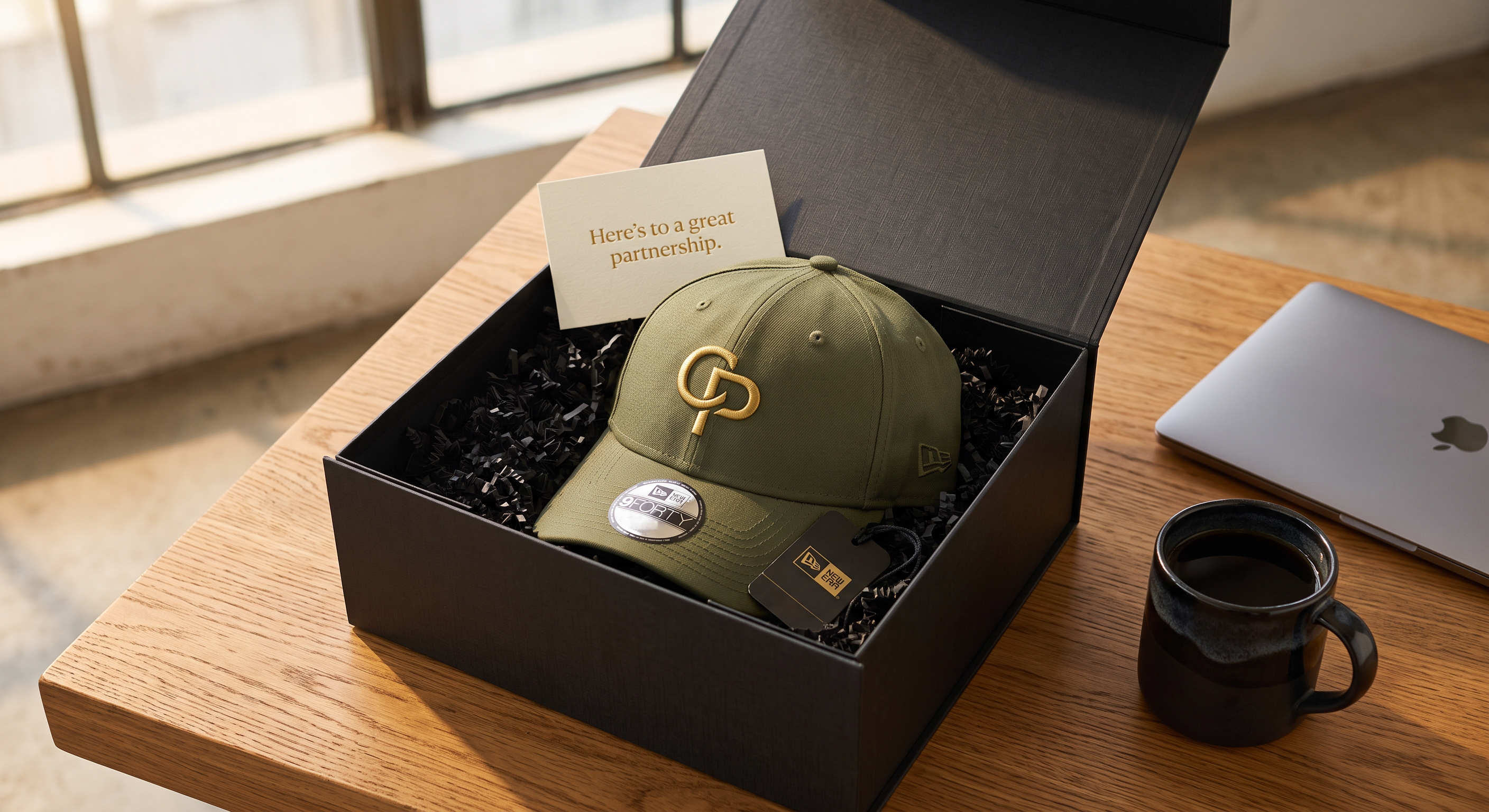
- A client gift lands when the branding is quiet: a pressed-in leather patch, thread near the hat color, or a small side placement.
- Spending more does not rescue a generic gift; buyers report $300 baskets resented and $35 local treats praised.
- Only $25 per recipient per year is deductible as a business gift; packaging and shipping don't count toward the cap (IRS).
- With no minimum, a short run for your top clients, even one carrying their logo, is a real order.
Table of Contents
- What Makes a Good Corporate Gift for a Client?
- Should the Gift Carry Your Logo or the Client's?
- How to Brand a Client Gift Quietly
- Luxury Corporate Gifts: What Reads as Premium
- Client Gift Budgets and the $25 Tax Rule
- Corporate Holiday Gifts for Clients: When to Send
- Ordering a Client Gift Run Without a Minimum
- Frequently Asked Questions
- Where to Start
Build the same cap two ways. The first carries your logo across the full front panel, stitched large in your brand colors. The second carries a small leather patch, your mark pressed into it with no color at all. The first cap advertises you. The second reads as a present.
Most corporate gifts for clients miss in one of two directions: too loud, or expensive but generic. This guide covers both problems. It walks through what clients keep, whose logo belongs on the gift, and how to brand one quietly. It ends with what the IRS lets you deduct and when the gift should arrive.
What Makes a Good Corporate Gift for a Client?
A good corporate gift for a client is something they would keep if it carried no logo at all. Quality and usefulness do the work; the branding rides along. Buyers in business forums draw this line as a hard boundary: a gift is not a promotion. Recipients can tell which one they are holding within seconds.
The failure mode shows up in their own words. One business owner described the standard client-gift box: a diary, a pen, some dried fruit. Their verdict was that it "ends up in a drawer."
Spending more does not fix it.
In one long forum thread, real estate agents compared closing gifts. One had given clients a $300 basket, a grill, and a big-screen TV. Two of those clients asked for the money instead. Meanwhile, a $35 box of fudge from a local shop drew more thanks than any basket. The recipients explained the logic plainly. A large generic gift is a chore to deal with. To some, it reads as their own fee coming back as an object they never chose.
What does get kept is quality that earns daily use. In another thread, a business owner still gets photo texts about the camping hammocks they gave clients 10 years ago. A supplier's gift backpacks became the only bag an entire sales team carries. We covered the same bar on the employee side in our employee gifts guide: keep-worthy means useful and good enough to buy at retail. Clients grade harder, because they never joined your company; they just work with it.
A well-made cap clears that bar when the logo is handled right, which the next two sections cover. If you would rather judge the products first, shop custom hats and look at the caps before thinking about the branding.
Should the Gift Carry Your Logo or the Client's?
There are three honest answers: your logo kept small, no logo, or the client's own logo. Each sends a different message, and all three beat a large version of your mark.
Your logo, kept small, works like a maker's mark on a good product. The hammocks and backpacks above all carried logos, and nobody minded, because the item earned its place first. Gifting professionals use a version of this test: would your client use it in front of their own clients? A small mark passes. A billboard fails.
No logo suits a formal relationship or a conservative industry. A plain, well-made gift with a handwritten note carries the relationship on its own, and the note is the part that gets kept.
The third option is the one almost nobody offers: put the client's logo on the gift. A short run of caps carrying their brand, made well, is a gift about them. It fits a milestone. A client opens a second shop, closes a funding round, or hits a 10-year anniversary, and you hand their team caps carrying their own mark. Because Griwolfe has no minimum on any customization method, 10 caps for a client's team is a real order. The tradeoff is honest: your name appears nowhere on the gift. The credit comes from the story, because they know who had them made.
Co-branding sits between these options and needs care. A gift carrying both logos claims a partnership. Use it only when the relationship genuinely is one, like a supplier and a retailer who sell together.
| Whose logo | When it fits | What it signals |
|---|---|---|
| Yours, kept small | Ongoing relationships; the default | A maker's mark on a product worth keeping |
| No logo | Formal or conservative relationships | The note and the quality carry it |
| The client's own | Milestones: openings, funding, anniversaries | The gift is about them, and you made it happen |
| Both (co-brand) | Real partnerships only | A claimed relationship, so it must be true |
How to Brand a Client Gift Quietly
Quiet branding is a build decision made in three places: the customization method, the colors, and the placement.
Method first. A debossed leather patch is quiet by construction. The mark is pressed into the leather, so the design reads as texture and shadow with no added color. Laser engraving burns the same mark in with finer line detail. Both come in genuine or faux leather, and our leather patch guide covers the materials in depth. In thread, the equivalent is tonal embroidery. Pick a thread color close to the hat color, navy on navy or tan on khaki, and the logo becomes a detail people notice second.
Color accuracy is worth knowing before you commit. Patch colors match a specified Pantone exactly. Embroidery thread is matched to the closest available thread color, which is close but never promised exact. For a gift that must sit in strict brand colors, a patch is the safer route. For a tonal build, the thread palette leaves plenty of room.
Placement does the rest. A design on the side panel, or arched above the back closure, stays small by position alone. A side design runs up to 3 by 2 inches. The full front panel is the loudest spot on a hat. Client gifts often skip it, or use it for a small centered mark.
None of this requires a designer. Pick a placement and customization method on the product page, then put your design on the hat. You see it on the actual cap before you order. If a patch suits your logo, browse custom patch hats to start from the right products.
Luxury Corporate Gifts: What Reads as Premium
Luxury corporate gifts signal through the object, the label, and the presentation. The price barely registers, because the recipient never sees it.
The object comes first, because recipients read quality with their hands. They feel the structure of the crown, the fabric, the stitching, the weight of a leather patch. A cheap cap with an expensive logo is still a cheap cap.
The label inside is part of the message. We carry New Era, Nike, Carhartt, and Richardson among other brands. A recognized name on the inside tag changes how the gift reads the moment a client turns it over. Buyers consistently prefer recognized retail brands in premium gifting, and the tag is where that recognition happens.
Presentation carries more perceived worth than most buyers expect. One recipient posted a client gift to a hobby forum, worried it was too expensive to accept. It turned out to be a modest set in careful packaging. The care was what had read as luxury. We offer custom inside labels and branded packaging on request; ask our team about either when you order.
A wearable gift also keeps working after the handoff. ASI's 2026 Ad Impressions Study measured headwear at roughly 4,000 impressions over its lifetime. Read that number correctly: it only accrues if the hat is good enough to wear. That is the argument for putting the budget into the product itself.
Client Gift Budgets and the $25 Tax Rule
Budget by relationship, and stop before impressive. The forum evidence earlier in this guide points one direction. A modest, well-chosen gift outperforms an expensive generic one, and past a point extra spend works against you.
Restraint also protects the recipient. Many companies cap what their people may accept, and government, finance, and healthcare run the strictest gift policies. A modest gift clears most of those rules quietly; a lavish one can force a client into an awkward return.
The tax rule is the part almost no gift guide mentions. Under IRS Publication 463, a business can deduct no more than $25 in business gifts per recipient per year. You can spend more, and for a key account you often will; only $25 of it is deductible.
One detail in the same rule is friendly to a well-presented gift. Incidental costs do not count toward the cap; the IRS names engraving, packaging, insuring, and mailing as examples. Whether a specific cost qualifies is a question for your accountant, but the cap is not as tight as it first sounds.
The rule also has a floor. Items costing $4 or less, carrying your permanently imprinted name, and distributed widely are classed as advertising expenses. The $25 gift cap never applies to them. That exception describes the trinket tier: the pens, keychains, and branded clutter recipients already told us about. The IRS and your clients sort those into the same category.
Corporate Holiday Gifts for Clients: When to Send
December is the hardest month for a client gift to land, and it is when almost all of them arrive. What makes a holiday gift appropriate does not change in December: quality first, branding quiet, spend sized to the relationship. What changes is the competition. Your box shares the week with every other company's, and office closures leave some gifts sitting in mailrooms until January.
Two timing moves beat the pile. The first is arriving early: a gift that lands between Thanksgiving and the first week of December gets opened, worn, and remembered before the rush. Count back from your target date. The design proof arrives by email within 1 to 2 business days of ordering. Standard production is 2 weeks for embroidery and printing, and 4 weeks for patch methods, from proof approval. US shipping is free, excluding Alaska. If the math gets tight, rush service runs as low as 3 business days; arrange it by phone, email, or live chat before you order.
The second move is skipping the season entirely. Agents who gift professionally report that a present sent a month after a closed deal lands harder than one more December box. The recipient has settled, nothing else competes for attention, and the gesture stands on its own. The same logic covers referral thank-yous and project wrap-ups: tie the gift to the moment you are grateful for.
Ordering a Client Gift Run Without a Minimum
Start by splitting your client list into tiers: a handful of key accounts, a wider middle, and everyone else. The top tier gets the premium build, a better cap with a leather patch and real packaging. The middle gets a clean tonal embroidery run. For the rest, a card with a genuine sentence in it beats a cheap object.
No minimum is what makes the tiers practical. We produce as low as 1 unit of any customization method. A top tier of eight clients is an order of eight, and a run for one client can be five caps. There is no setup fee and no artwork fee at any quantity.
The proof step is what lets you perfect a gift before it exists. After you order, we email a design proof, and nothing goes to production until you approve it. Use the unlimited revisions deliberately for a gift. Check the thread color against the hat, look at the size of the mark, and shrink whatever reads louder than you intended.
Gifts can also ship straight to each client: one order can ship to multiple addresses on request, arranged with our team directly.
Frequently Asked Questions
Are corporate gifts for clients tax deductible?
Partly. The IRS caps the business-gift deduction at $25 per recipient per year, whatever the gift cost. Incidental costs such as packaging, mailing, and insuring do not count toward the cap. Items under $4 carrying your permanently imprinted name, distributed widely, are classed as advertising expenses. Confirm specifics with your accountant.
How much should you spend on a corporate gift for a client?
Match the relationship, and stop before impressive. Buyers consistently report that modest, well-chosen gifts draw more thanks than expensive generic ones; some recipients of lavish gifts asked for the money instead. A quality item chosen for the person, built and presented well, outperforms a $300 basket picked in bulk.
Can I put my client's logo on the gift instead of mine?
Yes. A short run of caps carrying your client's own logo reads entirely as a gift about them. It suits a milestone like an opening or an anniversary. Griwolfe has no minimum on any customization method, so a run of five or 10 caps is a normal order for us.
When should corporate holiday gifts for clients arrive?
Between Thanksgiving and the first week of December, before the gift pile builds. Count backward from your target. The design proof comes within 1 to 2 business days. Standard production runs 2 weeks for embroidery and printing, or 4 weeks for patch methods. Rush service, as low as 3 business days, is arranged by contacting us directly.
What client gifts don't end up in a drawer?
Useful, well-made items with quiet branding. Buyers report keeping and using quality gifts for years: good bags, good tools, good caps. The pattern in every story is the same. The item earned daily use on its own, and the small logo came along with it.
Where to Start
A client gift comes down to three decisions made before checkout. Whose logo goes on it: yours kept small, none, or the client's own. How quiet the build is: debossed leather, tonal thread, a side placement. And when it lands: ahead of the holiday pile, or a month after a win, when nothing competes with it.
Decide those three and the rest is mechanical. Pick a well-made cap, put the design on it, and check the emailed proof before anything is produced. Browse the Custom Hats collection →
Have a question about your order? Contact us. We'll get back to you the same day.
Share:
Hat Embroidery Methods: Flat, 3D Puff, and Chain Stitch
Richardson 256 Hat: Umpqua Specs, Fit, and 256 vs 256P