

Key Takeaways
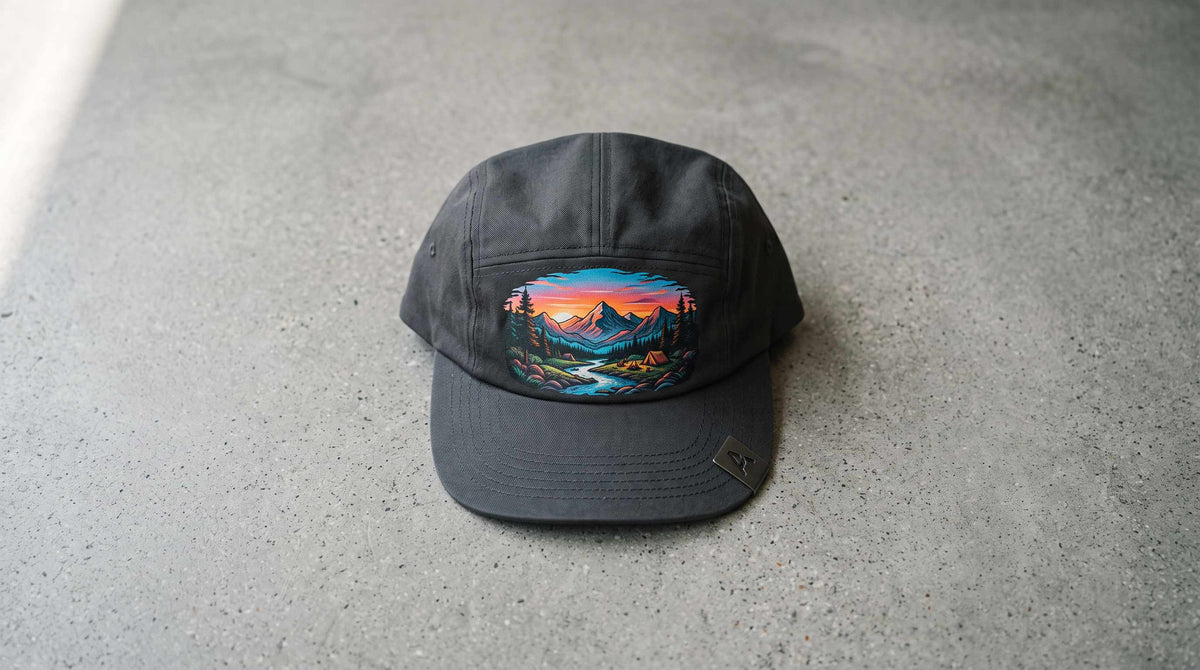
- Printing puts every color of your artwork on the hat at once, so gradients and photos reproduce as drawn.
- DTF technology presses the design into the fabric, where it becomes part of the hat.
- A print sits flat and smooth; embroidery stays the pick for raised texture.
- No minimum, no setup or artwork fee, standard production in 2 weeks.
Table of Contents
- What Is Printing on a Custom Hat?
- How Does DTF Printing Work?
- Printing vs Embroidery vs Patches on a Hat
- Which Hats Show a Print Best?
- Do Printed Hats Crack or Peel?
- How to Order a Printed Hat
- Frequently Asked Questions
- When Printing Is the Right Call
Most custom hats are embroidered, and for plenty of logos that is the right call. You print a custom hat when the artwork outruns thread: gradients, photographs, fine multicolor illustrations, or more colors than embroidery comfortably holds. The print carries every color of the design in one pass, so the color count never limits the artwork.
The guide below explains the method, the DTF technology behind it, when it beats embroidery or a patch, and how to order from one unit.
What Is Printing on a Custom Hat?
Printing is the customization method that puts your artwork on the hat as full-color ink. It is one of the three method families we offer, alongside embroidery and patches. There is no color limit: a printed design can hold gradients, photographic detail, and as many colors as the file carries.
Every printed hat we make is produced with DTF, short for direct-to-film. DTF is the technology; Printing is the method you order. On our product pages the option is labeled Print.
Printing also has no sub-options. Embroidery comes in three styles, and patches come in five types. A print is full color by nature, so once you pick it there is nothing further to choose.
One near neighbor is worth separating. A sublimated patch is full-color artwork printed onto its own fabric patch, which we hand-stitch to the hat; Printing goes on the hat itself. If the raised, bordered look is what you're after, shop custom patch hats. To see which styles carry printing, browse custom hats and open any product page.
How Does DTF Printing Work?
DTF is easiest to picture as two steps: print, then press. Your whole design prints in full color onto a film first, like a photo printing on paper. The film is then pressed onto the hat, and heat moves the ink from the film into the fabric.
The print step is what makes this different from thread. An embroidered design is built color by color, one thread at a time. A printed design arrives whole. A two-color wordmark and a 40-color illustration take the same run, and a gradient stays a gradient instead of being broken into solid blocks.
The press step is what separates a print from a sticker or an iron-on. The fabric absorbs the ink, so the design becomes part of the hat. A finished print is thin and flexible; it bends when the hat bends.
DTF also works across the materials hats are made of: cotton, polyester, blends, and foam fronts. That range matters, because hat fronts vary more than shirts do. The same method covers a cotton dad hat and a foam-front trucker, and it covers our apparel the same way.
Printing vs Embroidery vs Patches on a Hat
The three method families give three different results on the same hat.
| Printing | Embroidery | Patches | |
|---|---|---|---|
| Color capacity | Full color, no limit | Solid thread colors | Varies by type; sublimated is full color |
| Finish | Flat and smooth, ink in the fabric | Raised stitching | A raised separate piece, hand-stitched on |
| Standard production | 2 weeks | 2 weeks | 4 weeks |
| Goes on the strap | Yes | Yes | No |
| Strongest with | Gradients, photos, many-color art | Text-forward logos, a classic look | Dimensional, premium looks |
Embroidery builds a design from solid thread colors, so artwork with fades or photographic detail routes to print. The three embroidery styles and their size limits live in our hat embroidery methods guide. Patches trade the flat finish for a piece with real edges and texture, in five materials.
The honest tradeoff runs the other way too. A print is flat. Part of why people reach for embroidery is the raised thread you can feel, and no print reproduces that. If the logo would suit several methods, the choice is taste. To route each artwork type to the method that reproduces it best, see our guide to putting a logo on a hat.
Which Hats Show a Print Best?
A full-front print looks cleanest on a smooth, unbroken front panel. Foam-front truckers, 5-panel caps, and structured fronts without a center seam give the ink one flat surface. Caps with a center front seam take printing as well; on those, the design is placed to work with the seam.
Printing also suits performance caps: the ink goes on without a needle passing through the moisture-wicking fabric.
Here is the printed design size each placement takes on a structured cap. These are production limits, phrased as maximums; a specific product can run smaller, and your design proof confirms the exact size and placement before production.
| Placement | Printed design size (up to) |
|---|---|
| Full front | 6 x 2.3 inches |
| Front-left or front-right panel | 2.75 x 2 inches |
| Back, above the closure opening | 4 x 2 inches |
| Left or right side | 3 x 2 inches |
| Strap (adjustable caps; fitted have none) | 2 x 0.375 inches |
The strap is a quiet advantage here: it takes embroidery and printing only, so a patch can never go there. Beanies run the other direction. Knit takes no printing, so a beanie order routes to embroidery or a patch.
Do Printed Hats Crack or Peel?
A properly made print does not crack or peel in normal wear. When a printed hat fails, the cause is almost always production: cheap materials, or pressing at the wrong temperature. The printed-versus-embroidered durability question comes down to the same thing: made well, both hold up; made cheaply, either can fail.
On print-on-demand forums the same story repeats. A supplier's website showed a crisp mockup, the delivered hats looked nothing like it, and the fix was months of support email. The missing step in every one of those stories is a real proof.
A mockup is a picture of what your design might look like. A design proof is the production-ready version of your actual order, prepared by the people making it. We print and press in-house in the USA. Your proof arrives by email within 1 to 2 business days of the order, with unlimited revisions until it's right. Production starts only after you approve it.
One limitation is worth stating plainly: a print is a flat finish with a modern, graphic read. It will not give you the dimension of 3D puff embroidery or the heft of a leather patch. A brand built on that texture should pick those methods instead.
How to Order a Printed Hat
Ordering a printed hat runs through the same self-serve flow as every method we offer.
- Open the product page of the hat you want. It lists the placements you can customize: on most caps, the front, back, left, and right.
- Pick a placement and select Print as its method. Then click Customize to open the Design Studio.
- Build the design. Upload your logo as a PNG or JPEG, or create a design from scratch with the shape and text tools. The live preview shows it on the actual hat as you work. Have a different file type, like an AI (.ai) file? Email it to custom@griwolfe.com and our design team brings it in.
- Set the quantity and order. There is no minimum, so you can order 1 printed hat to hold before committing to a run. There is no setup fee and no artwork fee, and U.S. shipping is free.
- Approve your design proof. We email a production-ready proof within 1 to 2 business days. Request as many revisions as you want; production begins after your approval.
- Production and delivery. Standard production for printing is 2 weeks from proof approval. Need it sooner? Rush service runs as low as 3 business days: reach us by phone, email, or live chat and we'll work with your deadline.
Anything specific the Design Studio doesn't cover, write into the placement's Add note field. Our design team handles it and you'll see the result on your proof.
Frequently Asked Questions
Can you print on hats?
Yes. Printing works on most cap styles: truckers, snapbacks, dad hats, 5-panel caps, and performance caps. The design is pressed into the fabric in full color using DTF technology, with no minimum order. Beanies are the exception, since knit takes embroidery and patches instead.
What is DTF printing?
DTF stands for direct-to-film. Your design is printed in full color onto a film, then pressed onto the hat with heat until the fabric absorbs the ink. It is the technology behind our Printing method, and it reproduces gradients, photos, and any number of colors.
Do printed hats fade in the wash?
A well-made print holds up through normal wear and washing. The cracking and fading stories you'll read online usually trace to cheap materials or rushed pressing, so the producer matters more than the method. Griwolfe prints in-house, and production starts only after you approve the design proof.
What is the difference between Printing and a sublimated patch hat?
Printing puts full-color ink directly on the hat itself. A sublimated patch carries the full-color artwork on a separate fabric patch, which is hand-stitched to the hat. Both reproduce gradients and photos; the patch adds a raised, bordered piece where a print stays flat.
When Printing Is the Right Call
Pick printing when the artwork decides for you: a gradient, a photograph, an illustration, or a color count no thread palette covers. Pick embroidery or a patch when raised texture is the point. The ordering facts stay the same either way: no minimum, no setup or artwork fee, and a proof to approve before anything is produced.
Printing a custom hat starts on the product page, and the live preview shows your design on the hat before you spend anything. Design custom hats and see your artwork in full color.
Have a question about your order? Contact us. We'll get back to you the same day.
Share:
Richardson 112 vs 115: Which Fits Your Head and Your Logo
Hoodie vs Sweatshirt: Which One Takes a Logo Better