

Key Takeaways
- A hoodie is a sweatshirt with a hood; the merch difference is the front canvas.
- Hood seam, drawcord, pocket, and zipper all trim where a design can sit. The crewneck stays clean.
- Gildan's hoodie and crewneck share the same 8-ounce fleece and sizing; the hood is the warmth difference.
- Every customization method works on both, with no minimum.
Table of Contents
- What Is the Difference Between a Hoodie and a Sweatshirt?
- Which Takes a Logo Better, a Hoodie or a Crewneck Sweatshirt?
- What Is a Hoodie with a Zipper Called?
- Hoodie vs Crewneck: Same Fabric, Different Features
- Which Should Your Team or Brand Order?
- Frequently Asked Questions
- Hoodie vs Sweatshirt: Deciding for Your Merch
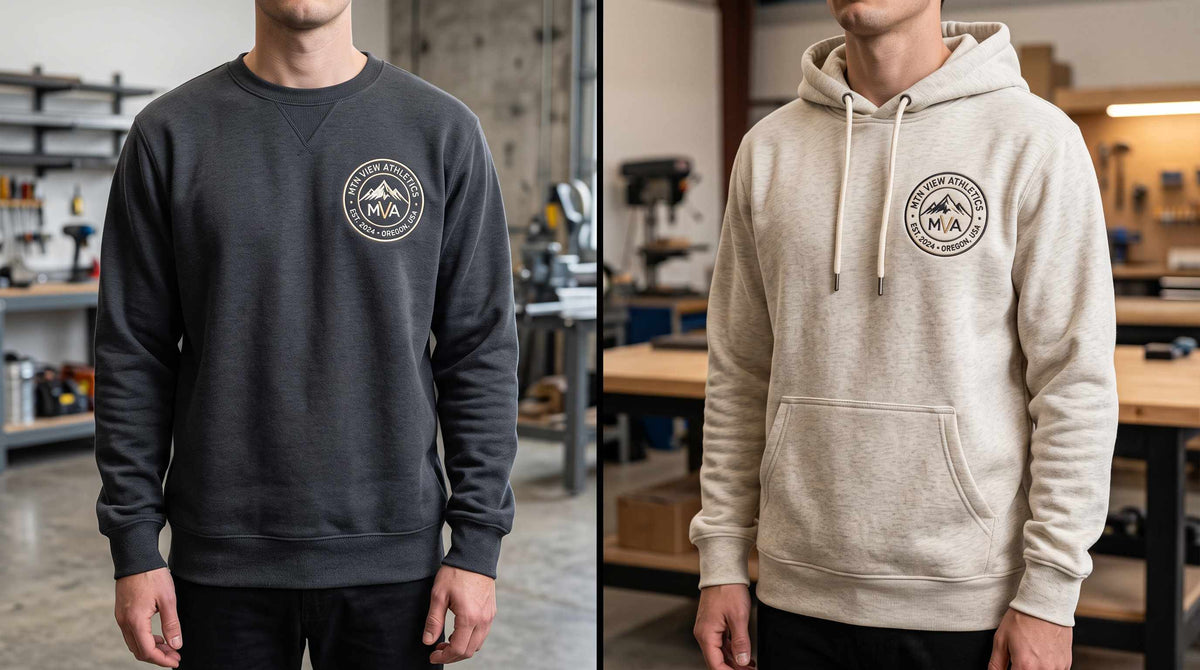
Put the same logo on a hoodie and on a crewneck sweatshirt, and it will not sit the same way on both. The hoodie brings a hood seam, a drawcord, and usually a pouch pocket to the front of the garment. The crewneck offers plain fleece from collar to hem.
The short answer to the hoodie-versus-sweatshirt question is the hood. The useful answer, for anyone buying branded merch, is what those features do to a logo. This guide covers where a design can sit on each garment, what a zipper changes, and what the spec sheets say about fabric and warmth. It closes with which garment fits which kind of order.
What Is the Difference Between a Hoodie and a Sweatshirt?
A hoodie is a sweatshirt with a hood. Sweatshirt is the parent category: a warm knit pullover, usually a cotton-polyester fleece with a soft brushed interior. Add a hood and a drawcord and it becomes a hoodie. Leave the neckline round and it is a crewneck sweatshirt, the version most people picture when they say sweatshirt alone.
The naming runs in one direction. Every hoodie is a sweatshirt, but a crewneck is not a hoodie, which is why catalogs list the two side by side. A sweater is a different garment entirely, knitted from yarn rather than sewn from fleece.
Most hoodies also carry a pouch pocket across the lower front. Many come in zip-up versions, which have their own naming and their own section below. None of those features change what the garment is made of. They change where a logo can go.
If you already know which garment your team wants, browse custom hoodies and see your logo on the real garment before you order anything.
Which Takes a Logo Better, a Hoodie or a Crewneck Sweatshirt?
A crewneck sweatshirt gives a logo the cleaner canvas. Nothing interrupts the fleece between the collar and the hem, so chest and upper-back designs sit on one flat panel. A hoodie takes every standard placement too, but its features set the edges. The drawcord ends hang over the center chest, the pocket takes the lower front, and the hood seam crosses the top of the back.
Three customization methods apply on both garments: embroidery, patches, and Printing, our full-color method. Here is what we produce on a hoodie, stated as production limits. A specific garment's own limit can be smaller, and the design proof confirms the exact size before production.
| Placement | Up to (inches, width x height) | Notes |
|---|---|---|
| Left or right chest | 4 x 4 | the default logo spot; every method |
| Center chest | 8 x 8 | printed at full size; embroidery and patches run up to 4 x 4 |
| Full front | 14 x 10.5 | Printing only |
| Upper back | 14 x 5 | the wide strip below the hood seam |
| Full back | 14 x 16 | Printing only |
| Sleeve | 3.5 x 3.5 | every method |
| Cuff | 3 x 2 | patches and Printing |
Two numbers in that table do most of the deciding. Embroidery and patches run up to 4 x 4 inches on apparel, so a bigger graphic is a Printing job on either garment. And a hoodie's full-front box is shorter than a tee's (up to 14 x 10.5 inches against 13 x 17), while its back stays large. For a standard chest logo up to 4 x 4 inches, the two garments are even.
The crewneck's advantage shows at the upper back and the center chest. With no hood seam and no drawcord in the way, both spots sit clean. That is why the back of a crewneck is the classic home for an arched team name. If that is the look you are after, shop custom crewneck sweatshirts and put your design on one.
What Is a Hoodie with a Zipper Called?
A hoodie with a zipper down the front is called a zip-up hoodie or a full-zip hoodie. Both names describe the same garment. A hoodie without a zipper is a pullover hoodie. A zipper that stops partway down the chest makes the garment a half-zip or quarter-zip, and those usually skip the hood.
For a logo, the zipper cuts the front canvas in two. A full-front or center-chest design has nowhere to sit on a full-zip, because no single panel spans the chest. A left- or right-chest logo works the same as on any garment, and the full back is untouched by the zipper.
The zipper trade-off drives the choice between a full-zip and a pullover hoodie for merch. Pick the pullover when the design is the point, since a printed full front or a big back graphic needs the uninterrupted panel.
Pick the full-zip for people who put the layer on and take it off all day. The logo then sits on the chest or across the back. You can browse custom full-zip hoodies to compare the two silhouettes on real products.
Hoodie vs Crewneck: Same Fabric, Different Features
On the spec sheet, the hoodie and the crewneck are nearly the same garment. Gildan's Heavy Blend pair makes the case plainly: same fabric, same fit, same sizing chart, different features.
| Spec | Gildan Heavy Blend Hoodie (18500) | Gildan Heavy Blend Crewneck (18000) |
|---|---|---|
| Fabric | 8 oz/yd², 50/50 cotton/polyester | 8 oz/yd², 50/50 cotton/polyester |
| Fit | Classic fit | Classic fit |
| Ribbing | 1 x 1 rib with spandex | 1 x 1 rib with spandex |
| Hood | Double-lined, color-matched drawcord | None |
| Pouch pocket | None | |
| Body length, size M | 28 inches | 28 inches |
| Chest width laid flat, size M | 22 inches | 22 inches |
The Jerzees NuBlend pair repeats the pattern in a different fleece. The Jerzees NuBlend Pullover Hoodie and the NuBlend Crewneck Sweatshirt both run 8 ounces per square yard in a 50/50 blend. NuBlend fleece resists pilling, and its high stitch density gives prints a smoother surface.
The hoodie adds a 2-ply hood with grommets, a matching drawcord, and a pouch pocket. The crewneck's body is knit without side seams and carries set-in sleeves.
That settles the warmth question honestly. The fleece weighs the same on both. A hoodie is warmer roughly the way a hat makes you warmer: the hood covers your head and neck when it is up. Choose between the two on canvas and use, and let warmth follow from whether your people will ever raise the hood.
Which Should Your Team or Brand Order?
Crewnecks suit garments with a job: staff wear, uniform-adjacent layers, anything worn under a jacket or over a collared shirt. The clean panel takes an embroidered chest mark well, and the round neckline layers without bulk.
A pullover hoodie is the pick when the point is merch people reach for on their own time. Big printed back graphics and full-front designs live here, and the hood reads casual in a way a crewneck never will.
Full-zips fit crews that shed the layer all day. Service staff and field teams wear them open indoors and zipped outside, usually with an embroidered chest logo.
The method follows the artwork. A mark in one or two colors stitches cleanly, and multicolor or gradient art belongs to Printing. A patch gives a logo a raised, dimensional badge, and every patch we make is hand-stitched to the garment. For the order-size and logo-complexity call between thread and patches, the embroidery vs patch decision guide walks through it.
Whichever you pick, standard production is 2 weeks for embroidery and Printing, and 4 weeks for patch methods. Rush service is available, as low as 3 business days; contact us by phone, email, or live chat to arrange it. There is no minimum on any method, so a single piece to check the fit before a full run is a normal first order.
Frequently Asked Questions
Is a hoodie or a sweatshirt warmer?
They usually share the same fabric at the same weight, so the body of each garment insulates the same way. Gildan's Heavy Blend hoodie and crewneck both run 8-ounce, 50/50 fleece. The hoodie ends up warmer only when the hood is up and covering your head and neck.
What is the difference between a hoodie, a sweatshirt, and a sweater?
A hoodie is a sweatshirt with a hood, and a crewneck is a sweatshirt without one. A sweater is knitted from yarn rather than sewn from fleece fabric, so it reads dressier and drapes differently. For branded merch, the hoodie and the crewneck are the pair to choose between.
Can you embroider a hoodie?
Yes. Embroidery on hoodies and other apparel runs up to 4 x 4 inches, and the left or right chest is the standard spot. Thread suits marks in a few solid colors; artwork with gradients or many colors comes out better in Printing, our full-color method.
Can you print the front and the back of a hoodie?
Yes. Front and back are separate placements, and each carries its own design. A printed full back runs up to 14 x 16 inches on a hoodie, and a full front up to 14 x 10.5. You design each placement on the garment and see both in the live preview.
Do hoodies cost more to customize than sweatshirts?
The customization price works the same way on both garments, reflecting the product, the method, and the quantity. Per-unit price falls as the order quantity grows, on either garment. There are no artwork or setup fees, and the Design Studio is free to use.
Hoodie vs Sweatshirt: Deciding for Your Merch
Settle the hoodie or sweatshirt choice with three questions. Where will the logo sit? A back or center-chest design favors the crewneck's clean panel, or a pullover hoodie printed large.
Will people wear it off the clock? The hoodie wins casual wear, and the crewneck dresses up more easily. Does the crew need to shed the layer? Then it is the full-zip, with the logo on the chest.
Whichever way the answers point, the process is the same. Pick the garment, upload your logo in the Design Studio, and see it on the actual product before you order. After you order, we email a design proof within 1 to 2 business days, and you get unlimited revisions before production starts. Design your custom hoodies or crewnecks now; with no minimum, the order can be as small or as large as the team needs.
Share:
Custom Hat Printing: Full Color, Gradients, No Minimum
Golf Tournament Gifts: What to Give at Every Prize Tier