

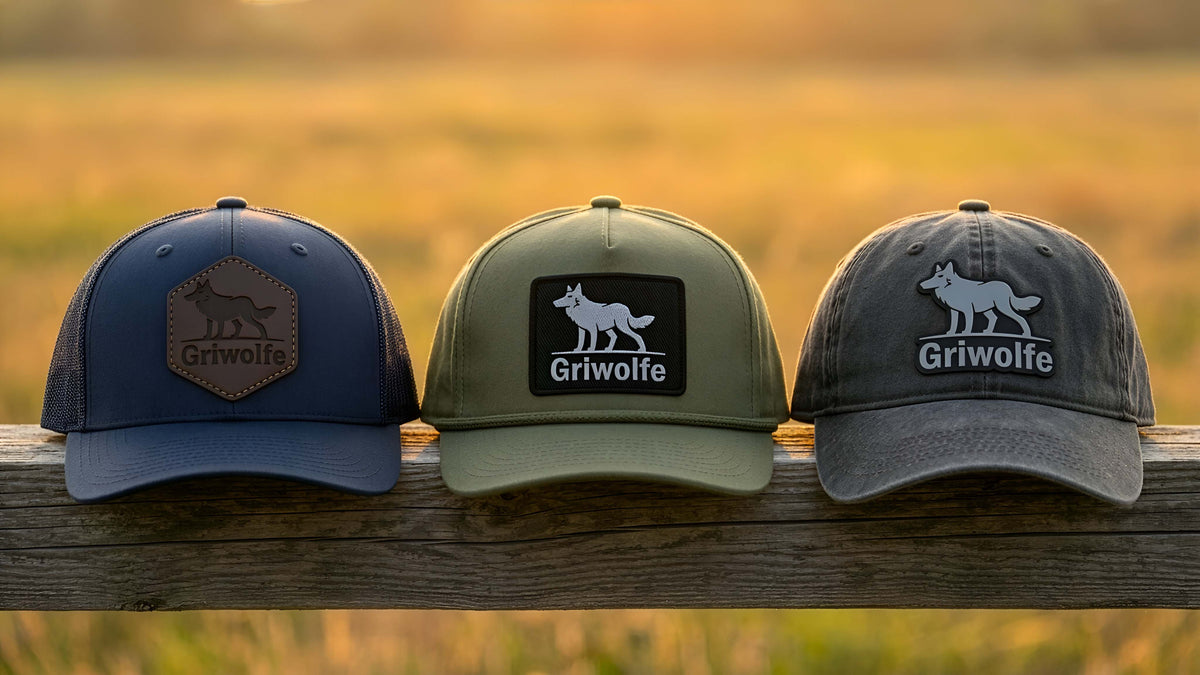
Key Takeaways
- Four choices settle a patch hat order: the patch type, the hat, the patch size, and the file you upload.
- A front patch runs up to 6 by 3 inches; sides and back take embroidery or printing.
- Every patch is hand-stitched to the front of the hat.
- No minimum on any patch type: one hat is a real order.
Ordering a custom patch hat means settling four things. Which patch type carries your logo, which hat it sits on, how big the patch is, and what file you upload. Everything else happens after checkout, where we email a proof within 1 to 2 business days and then hand-stitch every patch in-house. Standard production is 4 to 6 weeks from the day you approve that proof. This guide takes the four choices in order, gives the sizes, and walks through the order itself. We make custom hats and apparel in-house in the USA, with bags coming, so the numbers below are what we produce.
Table of Contents
- What Is a Custom Patch Hat?
- Which Patch Type Do You Order?
- How Is the Patch Attached to the Hat?
- Which Hat Styles Take a Patch?
- How Big Can a Patch Be on a Hat?
- What File Do You Need for a Patch?
- How to Order Custom Patch Hats Online
- Frequently Asked Questions About Ordering Patch Hats
- Pick the Patch, Then the Hat
What Is a Custom Patch Hat?

A custom patch hat is a hat with your logo made first as a separate piece, the patch, and then hand-stitched onto the front panel. Direct embroidery stitches thread into the hat fabric itself. A patch is made on its own, from leather, woven thread, molded PVC, sublimated fabric, or embroidered fabric, and then sewn on. That is why a patch hat can look like leather or rubber, which thread alone cannot do.
The patch also frames the logo. It has its own edge, its own background color, and its own texture, so the logo reads as a badge instead of stitching. Buyers pick patch hats for merch that customers pay for, for outdoor and trade crews, and for golf and brewery programs. In each case the hat has to look like a product.
Hats earn that effort. In ASI's 2023 Ad Impressions Study, 20 percent of consumers were more likely to do business with an advertiser who gave them logoed headwear. A hat that looks right gets worn, and a worn hat keeps working.
The five patch types below cover every patch we make. If you already know yours, browse custom patch hats and open any product page to start.
Which Patch Type Do You Order?
We make five patch types: leather, embroidered, woven, PVC, and sublimated. Each one has a choice or two to settle before checkout, and the table lists them. Our patch hats guide goes deeper on each material, and the guide to choosing the right patch type walks a logo through the decision.
| Patch type | Best for | Colors | What you decide before checkout |
|---|---|---|---|
| Leather | Bold marks and wordmarks; outdoor, golf, brewery, trades | The leather color plus the debossed or engraved tone; colored deboss adds fill colors | Genuine or faux leather; debossed or laser engraved; standard or colored deboss |
| Embroidered | Team marks, badges, traditional logos | About 7 to 8 thread colors | Flat or 3D puff stitching |
| Woven | Small text, thin lines, detailed logos | About 7 to 8 colors | Background and border colors |
| PVC | Outdoor, marine, tactical; exact brand colors | About 7 to 8 colors, Pantone matched | 2D (flat layers) or 3D (rounded, sculpted) |
| Sublimated | Photos, gradients, full-color art | No limit | Border color |
Leather patches
A leather patch carries your logo pressed into the surface (debossed) or laser engraved. Colored deboss adds color to the pressed logo, so a two-color mark works on leather. Before checkout you pick genuine or faux leather, the leather color from the swatches in the Design Studio, and debossed or engraved. Leather suits bold shapes and clean lettering; fine text is better on a woven patch.

Embroidered patches

An embroidered patch is your logo stitched onto a fabric patch base, which is then hand-stitched onto the hat. It gives the thread texture of embroidery with a framed edge. You choose flat stitching or 3D puff, where foam under the thread raises the design. Flat suits detailed logos; 3D puff suits thick letters and simple shapes.
Woven patches

Small text and thin lines stay sharp on a woven patch, because the logo is woven into the patch fabric with fine threads. It is the patch for a tagline, a serif wordmark, or a logo with many small parts. The surface is smooth and flat rather than raised. Before checkout you set the background and border colors.
2D PVC patches

A 2D PVC patch is soft molded rubber with the logo built in flat layers, each with a sharp vertical edge. It is waterproof, holds color in the sun, and matches Pantone colors exactly. Pick 2D for text, clean logos, and anything technical.
3D PVC patches

Rounded, sculpted surfaces are what set a 3D PVC patch apart from the flat tiers of 2D, in the same rubber. Pick 3D for mascots, animals, and any logo that should look lifelike. The 2D-or-3D choice is the one PVC decision you make before checkout.
Sublimated patches

Photos and gradients belong on a sublimated patch, where the artwork is printed into the patch fabric in full color with no limit. It is the patch for a photo, a gradient, or a logo with more colors than thread can carry. Fine text prints, but it does not get the woven patch's sharpness. Before checkout you set the border color.
How Is the Patch Attached to the Hat?
Every patch we make is hand-stitched to the hat with thread around its edge, on every hat style, including beanies. There is no attachment option to choose at checkout. The stitched border is what keeps a patch on a cap through washing, rain, and years of wear.

You can see the difference on the patch itself. A hand-stitched patch shows a line of thread inside its edge, as on the left above. A glued patch has a bare edge, as on the right, and that is the version we do not make. The stitching adds a small detail that reads deliberate on leather and embroidered patches, and it disappears into the border on woven and PVC.
Which Hat Styles Take a Patch?
A structured front panel holds a patch flat, so structured truckers, five-panels, rope hats, and performance caps take every patch type. An unstructured hat curves the patch with the crown, which looks right for a relaxed dad hat but softens a large flat patch. The models below are the ones we see most in patch orders, with the facts that matter from each maker's spec sheet.
| Hat style | Model | Construction | Patch note |
|---|---|---|---|
| Trucker | Richardson 112 | Structured, six-panel, mid profile, mesh back | Takes every patch type; one of our best sellers by quantity |
| Five-panel trucker | Richardson 112FP | Structured, five-panel, mid profile, mesh back | No center seam, so a wide patch sits on one flat panel |
| Washed trucker | Legacy OFA | Unstructured, six-panel, low profile, washed twill and mesh | Leather or embroidered patch on a lived-in crown |
| Retro trucker | YP Classics 6606 | Structured, six-panel, mid profile, mesh back | Takes every patch type; retro proportions |
| Rope hat | Richardson 256 | Semi-structured, five-panel, low profile, rope braid, flat bill | Leather and woven patches above the rope |
| Performance rope hat | Imperial 5054 | Structured, five-panel, mid profile, recycled polyester, rope braid | Leather or PVC patch for golf and outdoor programs |
| Dad hat | 47 Brand 4700 | Unstructured, six-panel, low profile, garment-washed cotton | Small woven or leather patch; keep it compact |
Trucker hats are the standard patch base for a plain reason. The front panel is flat and firm, and the mesh back keeps the hat wearable in heat. The Richardson 112 and the YP Classics 6606 give a structured mid-profile front that takes any of the five types. The Legacy OFA is the unstructured version of that look, with a washed crown that suits a leather or embroidered patch. You can shop custom trucker hats across all three.
Rope hats add a braid along the seam above the bill, and a patch sits above it on the front panel. The Richardson 256 is the low-profile choice for golf and outdoor brands; the Imperial 5054 pairs the rope with performance fabric and a moisture-management sweatband. Leather and woven patches read best on both. A dad hat like the 47 Brand 4700 works with a compact patch, since the soft crown curves anything wide.
How Big Can a Patch Be on a Hat?
A front patch runs up to 6 inches wide by 3 inches tall on a structured cap. No other customization method gets a larger box on a hat. A patch on the front left or front right panel runs up to 2.75 by 2 inches. On a beanie, the patch sits on the cuff at up to 4 by 2.3 inches.
On a hat, patches go on the front only. The back takes embroidery or printing up to 4 by 2 inches, and each side up to 3 by 2 inches. A front patch with embroidered text on the back is a normal build.
Most patch hats use less than the full box. To find your size, hold a ruler against the front of a cap you own and mark the width you want. Then shrink your logo on screen to that width and look at the smallest text. If it still reads, it will read on the patch.
The exact size is confirmed on your proof, in inches, before anything is made. A specific hat can carry a slightly smaller box than the numbers above, and the proof shows the box for the hat you picked.
What File Do You Need for a Patch?
Upload a PNG or JPEG of your logo in the Design Studio; both work today. If your logo lives in another format, email it to custom@griwolfe.com and we bring it in. You do not need a vector file to order. A logo that looks clean at the patch size on your screen is ready.
Colors work differently on a patch than in thread. Patch colors match a Pantone number exactly. If your brand has one, put it in the note field for that side and it shows on the proof. Embroidered, woven, and PVC patches carry about 7 to 8 colors comfortably; a sublimated patch has no limit. Leather carries its own tone plus the fill colors of a colored deboss. The studio reads the colors in your file and lets you swap each one for a named production color before you order.
If the logo has a background you do not want, the BG Removal button takes it off in one click. For anything else, live chat reaches our design team while you are in the studio. A note on the design is handled by the same team and shown on the proof.
How to Order Custom Patch Hats Online

The order runs from the product page, with no quote form and no sales call. Here is the sequence for a patch hat.
- Open the hat's product page and click Start designing. The Design Studio opens with the actual hat in front of you.
- Pick the Front, then choose Patch. The studio asks which side to design, then how that side is made. Choose Patch, then the patch type, and then the spot on the front. Each spot is a measured box drawn on the hat photo.
- Upload your logo or build it from text and shapes. Upload the file, then click its small preview to place it on the hat. Swap any color to a named production color, and use the note field for a Pantone number or any instruction.
- Add the sides or back if you want them. Those take embroidery or printing. Each side you use adds its own per-hat cost.
- Save & finish, then set quantities. Your design shows on the hat's own photos. Enter quantities and the page prices the order live, per hat, with the volume saving shown. Hats that share the same design, patch type, size, and placement count as one design group. Navy and camo caps with the same front patch price together.
- Check out. Payment is upfront by card or the usual wallets; we do not take purchase orders. U.S. shipping is free with no minimum order size.
- Approve your proof. Within 1 to 2 business days we email a production-ready proof. It shows the patch at its exact size in inches, its colors, and its placement on your hat. Revisions are unlimited and free, and nothing is made until you approve.
- Production and delivery. Standard production for patch hats is 4 to 6 weeks, counted from proof approval. Rush is available on request: call, email, or open live chat before you order and we confirm what is possible for your date.
| Step | What happens | Time |
|---|---|---|
| Design and checkout | Build the patch in the Design Studio, set quantities, pay | A few minutes |
| Proof | Emailed to you; unlimited revisions | 1 to 2 business days after the order |
| Production | Patches made and hand-stitched in-house | 4 to 6 weeks after approval |
| Shipping | Free within the U.S.; method chosen at checkout | Per the carrier's estimate at checkout |
There is no minimum on any patch type, so a first order can be one hat. A single patch hat costs more per unit than a run, because the patch has to be made either way. One-unit orders are not eligible for a refund. Most buyers who want to see the patch in hand order one, then place the run.
Frequently Asked Questions About Ordering Patch Hats
Do I have to order 24 custom patch hats?
No. There is no minimum on any patch type, so you can order one hat, twelve, or two hundred. A single patch hat costs more per hat than a run, and 1-unit orders are not refundable. To check fit and fabric first, an undecorated hat is available on request for a small fee plus shipping. Call or message us to arrange one.
Can I add embroidery on the side with a front patch?
Yes. Patches go on the front, and the sides and back take embroidery or printing in the same order. In the Design Studio, add the side after the front, choose Embroidery or Printing for it, and place the text or mark. Each side is priced on its own and shows on the same proof.
How do I know how big my patch will be?
Your proof states the patch size in inches before production. To settle it earlier, hold a ruler to the front of a cap you own and pick the width. Then shrink your logo on screen to that width. A front patch can run up to 6 by 3 inches on a structured cap, and most logos need less than that.
Does the same patch on two hat styles count as one order?
Yes, if the design, the patch type, the size, and the placement stay the same. A leather patch on the front of a Richardson 112 and the same patch on a 112FP form one design group. Volume pricing covers both. Changing the patch design or its colors, or moving it to a different spot, starts a separate group with its own pricing.
Do you need my logo as a vector file?
No. A PNG or JPEG uploads in the Design Studio, and that is enough for a patch order. If your logo is in another format, email it to custom@griwolfe.com and we bring it in. If your file is small or blurry, tell us in the note field and we handle it before the proof.
What does the proof show for a patch order?
The proof shows the patch on your chosen hat at its size in inches, with its colors and its placement on the front. It also carries the options you chose: the leather finish, 2D or 3D for PVC, flat or 3D puff for embroidered. Anything you wrote in the note field is handled and shown there too. You approve it or ask for changes, as many times as you need.
Can I get patch hats faster than 4 to 6 weeks?
Rush is available on request. Call, email, or open live chat before you order, tell us the date, and we confirm what is possible for your quantity and patch type. Ask before checkout, since rush is arranged with the order rather than added later.
Do you make patches on anything besides hats?
Yes. We make custom hats and apparel in-house, with bags coming, and a hand-stitched patch works on caps, beanies, and garments. On a beanie the patch sits on the cuff; on a hoodie or tee the studio lists the spots that take a patch. Each product page shows its own options.
Pick the Patch, Then the Hat
Choose the patch type for your logo and a structured hat if the patch is wide. Size it with a ruler against a cap you own. Those three decisions carry most of the order. When you are ready, design your custom patch hats on any product page and see the patch on the real hat before you pay. The proof comes to your inbox before anything is made.
Share:
Custom Hats Guide: Best Styles and Methods for Your Logo
Rope Hat Golf: Which Hat, Patch or Thread, and When to Order