
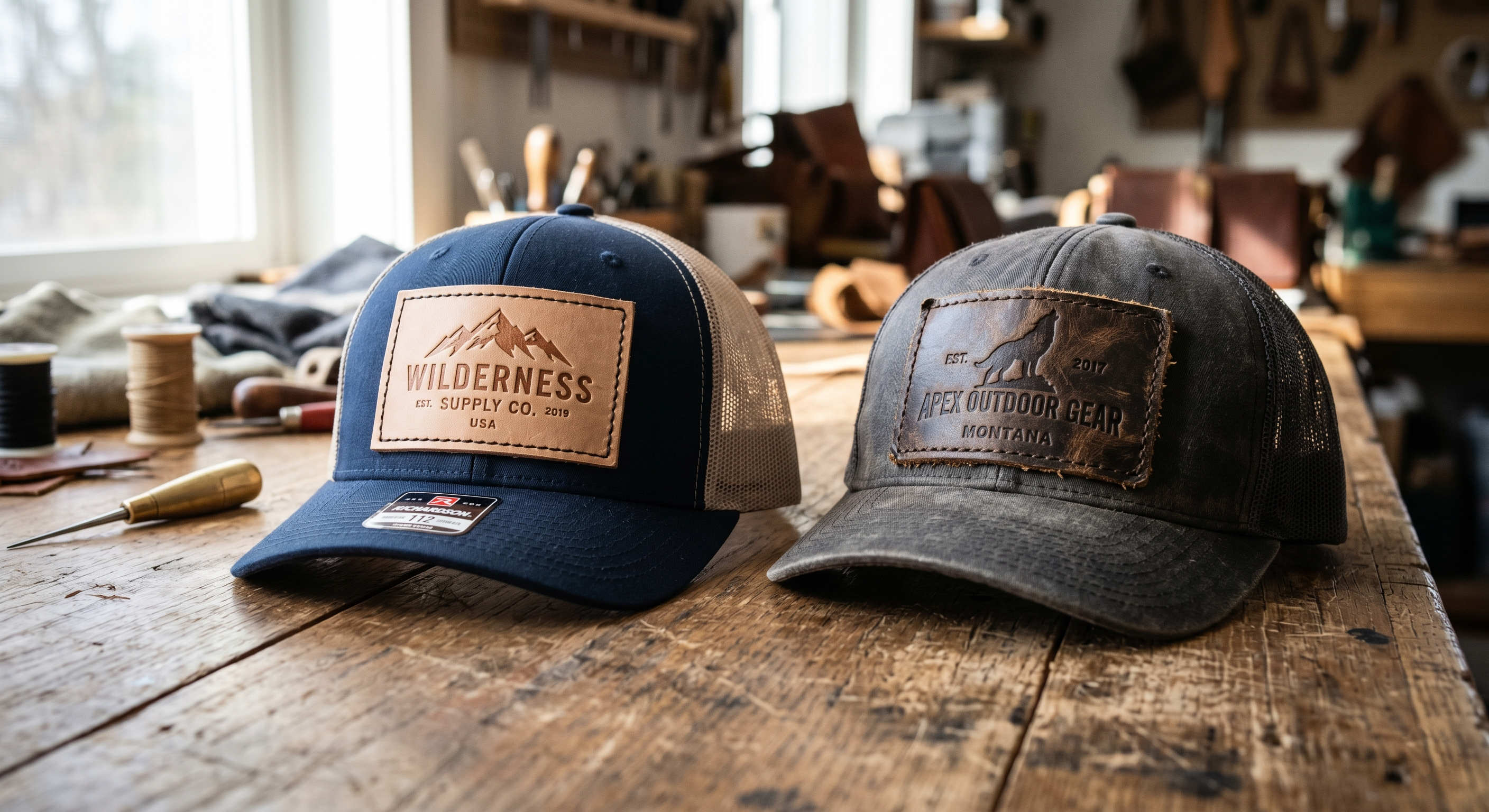
A design agency ordered 48 leather patch hats for a client launch last fall. By month three, the patches on the event hats were a washed-out taupe while the ones they kept for the studio still looked rich and dark. Same order, same box. The hats they kept had been worn daily; the event hats had sat in a hot warehouse window. The faux leather they assumed was full-grain could not take it.
A leather patch hat is the most popular patch type we make, and the one most buyers pick on vibe alone. This guide goes deeper: how to tell full-grain from faux in a product photo, which decoration method (deboss, laser, emboss, or screen print) holds up best, which hat shapes make leather look its sharpest, what the material does over three years, and how to care for one so it ages the way you want. We have shipped 5,000+ orders and 82,405 units of custom headwear, and the advice below is what we tell buyers before they fall in love with a mockup.
What Makes a Patch Hat "Leather"
If you want the fundamentals (what a patch hat is, how patches are attached, why sewn borders matter for durability), our patch hats guide covers all five patch types at overview depth. This article picks up where that guide's leather section ends.
Here is what makes leather different from every other patch type in one sentence: leather is the only patch material that actually ages. PVC is the same at month one and month sixty. Woven, sublimated, and embroidered patches hold their look until they fail. Leather changes. That single fact drives almost every decision in this guide, starting with whether you want the patch to evolve at all.
Full-Grain vs. Faux: How to Actually Tell

Full-grain leather is the outer hide of the cow, used as-is, with the natural grain pattern intact. Faux leather is polyurethane (PU) or bonded leather, manufactured to look similar. Both can be attached to a hat with a sewn border. Neither is wrong. But the two age on completely different curves, and most buyers cannot spot the difference in a product photo.
Here are the five things to look for before you approve a proof:
- Grain pattern randomness. Real full-grain has an irregular, slightly uneven surface pattern. The pores are different sizes. The grain flows in subtle directions. Faux leather has a perfectly uniform pattern, repeating at predictable intervals, because it was rolled or embossed from a template.
- Edge cut quality. A cut edge on full-grain shows a fibrous core. A cut edge on PU shows a clean, uniform layer that looks almost like fabric behind a plastic coating.
- Surface pore consistency. Full-grain has natural pores spread irregularly across the surface. Faux has either no pores or a repeated pore pattern.
- Weight and thickness. Full-grain patches feel heavier in the hand than faux of the same dimensions. A product photo cannot show this directly, but sample photos shot at an angle reveal thickness.
- How it photographs in direct light. Full-grain scatters light unevenly with small highlight variations. Faux reflects more uniformly, sometimes with a slight plastic sheen.
Over the next two years, full-grain darkens at high-wear points (the top edge of the patch where fingers grip the brim) and builds patina across the face. The change is asymmetric and develops over six to eighteen months. Faux holds its look almost unchanged for four to six months, then stops evolving and shows wear as uneven color loss rather than character. The agency we opened with learned that the hard way.
If the distinction matters for your brand, ask for a real product photo before approving, not a render or catalog stock shot, but a hat from the vendor's current production line in natural light. Design your leather patch hat in our tool, and the proof we send is the actual patch we will produce.
Decoration Methods on Leather: Deboss, Laser, Emboss, and Screen Print

The material is half the decision. The decoration method on the patch itself is the other half. Four methods cover almost every leather patch hat on the market, and they are not interchangeable.
Deboss. A heated metal die presses the design into the leather, leaving a recessed imprint with darker edges where the die concentrates heat. Classic, heritage, warm. Depth depends on die pressure and dwell time, so your vendor has some control over how subtle or sharp the outline reads. Deboss is the default for wordmarks, monograms, and simple shield logos, and it loses fine detail anywhere the line gets narrower than a few millimeters.
Laser engraving. A focused laser burns the design into the surface with more precision than a die. Laser holds finer text and thinner line art, including serifs and interior details deboss would smudge. The burned areas read as a faint contrast tone rather than a shadow, and there is no fill color. For clean line art or a wordmark with detailed type, laser beats deboss on detail capacity.
Embossing. The opposite of deboss: the design is raised above the surrounding leather. Less common on hat patches, more common on heritage leather accessories. Reads softer and more organic than deboss and pairs with natural, unfinished leather. Fine detail is harder because the raised edge needs surrounding material to support it.
Screen printing. Ink is applied directly to the leather, supporting full color, gradients, and multi-color logos. The tradeoff is aging: the ink does not patina with the leather. It sits on top, and on high-abrasion edges it can wear over multiple years. Screen print is the only leather decoration method for a full-color logo, which makes it a real option when the mark is specifically colored.
| Method | Look | Detail Capacity | Ages with Leather | Best Use Case |
|---|---|---|---|---|
| Deboss | Recessed, darkened edges, classic | Medium (loses fine lines) | Yes | Wordmarks, monograms, heritage brands |
| Laser engraving | Burned surface, subtle contrast | High | Yes | Fine text, line art, detailed logos |
| Embossing | Raised relief, softer read | Medium | Yes | Natural-finish leather, accessory-style looks |
| Screen print | Ink on surface, full color | Very high | No (ink does not patina) | Multi-color and gradient logos |
If your brand is a single-color wordmark or simple icon, deboss is usually the right call on cost and classic read. If the logo has fine text or intricate line art, move to laser. If it needs more than one color, screen print is the only option, and you accept that the ink will not age with the leather.
Which Leather Type for Your Use Case

"Full-grain" is not a single material. It is a category that includes several tanning and finishing processes, and the one that fits your hat depends on where the hat will live.
- Standard full-grain. The default. Smooth, consistent color, medium thickness. Fine for offices, events, corporate merch, and retail private label. Ages evenly with normal wear.
- Vegetable-tanned bridle. Tougher, darker, more water-resistant, traditionally used for saddlery and belts. Develops a richer patina than standard full-grain. Good for ranch, outdoor, equestrian, and heritage brands where the hat will get rained on or handled hard.
- Chrome-tanned. Softer, more consistent in color, holds dye well. Mid-priced and less prone to blotching. Good for brands that want uniform color across a run of 100+ hats.
- Oil-tanned. Water-resistant, darker, ages with heavier character. Popular for construction, trades, and workwear where the hat will take abuse and should look better for it.
| Leather Type | Feel | Water Resistance | Aging | Best Use Case |
|---|---|---|---|---|
| Standard full-grain | Smooth, medium weight | Moderate | Even patina | Office, events, corporate |
| Vegetable-tanned bridle | Firm, dense | High | Rich, directional patina | Ranch, outdoor, heritage |
| Chrome-tanned | Softer, more uniform | Moderate | Even, slower | Retail, large runs, consistency |
| Oil-tanned | Supple, heavier | High | Darkens with character | Construction, trades, workwear |
Not every specialty leather is a default stock option on every order. If you want vegetable-tanned bridle or oil-tanned specifically, contact the team before ordering so we can confirm availability for your hat style and quantity.
Leather Patches by Hat Style

Leather works on almost every hat style, but it does not work equally well on all of them. The ideal leather patch canvas is a hat with a flat, structured front panel (foam or twill) that gives the patch a consistent surface to sit flat against. Here is how each style actually handles a leather patch.
Structured truckers and 5-panel caps. The natural home for leather. A flat foam or twill front panel means the patch adheres evenly, the edges stay crisp, and it sits proud rather than pillowing. The Richardson 112 and similar structured truckers are the industry benchmark for leather patch hats for this reason.
Rope hats. Leather and rope are a heritage pairing. The combination reads Western, outdoor, or traditional before the logo even registers, which is why it dominates bourbon, ranch, and real estate merch.
Dad hats. The unstructured front panel curves gently under the patch, so edges read softer than on a structured cap. Fine for lifestyle brands where a gentler look is the goal.
7-panel caps. A rounder crown and premium silhouette. Leather patches look expensive on 7-panel; worth considering for upmarket lifestyle brands.
Snapback and flat bill. Both work. Leather reads heavier on flat bill streetwear, and that contrast can be intentional.
Beanies. Leather patches on beanies are hand-stitched through the knit fabric. Keep the patch shape simple (circle, rectangle, shield) because elaborate shapes are harder to anchor cleanly without heat-press adhesive.
Performance and athletic caps. Leather reads out of place on moisture-wicking technical fabric. PVC is the usual call there.
How Long a Leather Patch Hat Lasts (and What Kills One)
Two numbers to remember. A full-grain leather patch hat worn in a normal rotation remains fully presentable for five or more years, and many age into their second decade with nothing more than seasonal care. Faux leather holds its look for two to three years, then shifts into uneven fade territory rather than character.
Attachment durability and patch durability are two different questions. A sewn-border patch stays attached for the life of the hat. What ages or fails is the leather itself, and it fails in specific, predictable ways.
What damages the patch, ordered by how common the complaint is:
- Prolonged direct sun. Dashboards, sunny ledges, high-UV backyard use. Full-grain fades unevenly; faux goes pale and stiff.
- Salt water without reconditioning. Ocean spray or coastal sweat dries leather out and cracks it if left untreated.
- Prolonged high heat. A hat cooking on a dashboard in Texas summer. Leather shrinks, stiffens, and loses its supple feel.
- Hard abrasion. Tossed in a toolbox, pocketed with keys, riding loose in a truck bed. Scuffs cross the grain and do not buff out.
- Harsh chemical cleaners. Bleach, ammonia, and solvents strip finish and stain leather unpredictably.
Patina is different from damage. Even darkening across the face, lighter high-points where the cap rubs, and subtle color shifts at the edges are patina, and on full-grain they are desirable. Cracking, stiffness, uneven bleaching, and brittle edges are damage, usually from one of the five causes above.
Caring for a Leather Patch Hat

Leather patch hat care is simpler than leather shoe or jacket care, but it is not zero.
Cleaning. Spot clean only with a damp cloth, wiped gently with the grain. If the cap body needs cleaning, hand-wash in cool water with mild detergent, keeping the patch out of the water. No machine wash, no dryer.
Conditioning. Once per season, apply a neutral leather cream (not petroleum-based dressings, which darken leather unevenly and leave residue). Small amount on a clean cloth, rubbed into the patch, wiped off after a minute. Skip conditioning on faux leather; it will not absorb the product.
Sun protection. The biggest avoidable mistake is storing the hat on a dashboard or sunny window ledge. Keep it out of direct sunlight when not in use.
If it gets soaked. Air-dry away from heat: no hair dryer, no radiator. Once fully dry, condition with leather cream to restore moisture the water pulled out.
Ordering Leather Patch Hats
The ordering basics match every other patch type on our site. The minimum order for leather patch hats is 24 units. Design proofs arrive within 1 to 2 business days of placing the order, with unlimited revisions at no charge. Standard patch production is 4 to 6 weeks from proof approval, with faster turnarounds possible (as little as 4 weeks, or expedited on request if your deadline is tight). There is no artwork fee and no setup fee. All hats ship from Greensboro, North Carolina, with free standard shipping on US orders over $250.
For a full walkthrough of the ordering flow, proof process, and mix-and-match rules, read our guide to ordering custom patch hats. When you are ready to start, shop custom patch hats and build your design on the hat style you want. You will see the patch rendered in real time before you check out.
Frequently Asked Questions
How can I tell if a leather patch hat is real full-grain or faux?
Look at five things in the product photo: grain pattern randomness, edge cut quality, surface pore consistency, weight and thickness, and how the leather reflects direct light. Full-grain is irregular, fibrous at the edges, and scatters light unevenly. Faux is uniform, clean at the edges, and reflects more consistently.
Will a leather patch hat fade in the sun?
Full-grain leather develops even patina in normal sun exposure but fades unevenly under prolonged direct UV (dashboards, sunny ledges, full-time outdoor wear in high-sun climates). Faux leather fades faster and less evenly, usually within six months of hard sun exposure. Store the hat out of direct light when not in use.
Can you wash a leather patch hat?
Spot clean only. Use a damp cloth on the patch and hand-wash the cap body in cool water with mild detergent if needed, keeping the patch dry. Never machine-wash, never put it in a dryer, and never use harsh chemical cleaners. Condition full-grain with neutral leather cream once per season.
Are leather patch hats better than embroidered hats?
Neither is better; they are different looks for different jobs. Leather patch reads heritage, premium, and structured. Direct embroidery reads clean, quiet, and corporate. Leather has a 24-unit minimum; direct embroidery starts at 6. Pick leather for bold brand signaling and a patch you want to age; pick embroidery for smaller orders or quieter corporate contexts.
How long does a leather patch hat last?
A full-grain leather patch hat remains fully presentable for 5+ years with regular wear and seasonal conditioning. Many last a decade or longer. Faux leather typically holds its look for 2 to 3 years before visible fade or stiffening sets in. The attachment (sewn border) stays intact for the life of the hat in either case.
The Takeaway
Leather is the only patch type on a custom hat where the material itself keeps changing after you take it out of the box. That is either the whole point or a problem to manage, depending on how you want the hat to read in year three.
Three things to remember before you order:
- Material choice drives aging. Full-grain evolves and can outlast the hat body itself. Faux holds its look short-term and stops evolving. Pick based on whether you want character to build or stay consistent.
- Decoration method matters as much as material. Deboss for classic wordmarks, laser for fine detail, embossing for raised relief, screen print when you need full color and accept that the ink will not patina. The right method is the one your logo was designed for.
- Care is the multiplier. A full-grain patch that gets conditioned once a season and stays off the dashboard will outlast the same patch abandoned to sun and sweat by years.
When you are ready, open the design tool, upload your logo or build one from scratch, and see the patch rendered on the hat style you want before you commit. Start designing custom patch hats and you will have a live preview in under two minutes. Have a question about your order? Contact us, and we will get back to you the same day.
Share:
Patch Hats: The Complete Guide to Types, Styles, and Customization
PVC Patch Hats: 2D vs. 3D Rubber Patches for Custom Hats