

Key Takeaways
- An unwanted jacket is thrown away 11% of the time, a hat 25%, a calendar 48%; the rest get passed along (ASI 2019).
- One-size hats go to anyone who stops; sized tees, polos, and hoodies go to the people you talked to.
- Order hats for the conversations your staff can hold, plus a buffer, and keep the design undated.
- No minimum on any method, so a first show can be a 25-hat order.
Table of Contents
- What Are the Best Trade Show Giveaways?
- Which Trade Show Giveaways Do People Keep?
- Hats or Apparel: Which Wearable for Which Visitor
- How Many Trade Show Giveaways Should You Order?
- Sizing a Booth Apparel Order
- Planning Backward From the Show Date
- Frequently Asked Questions
- Before You Order
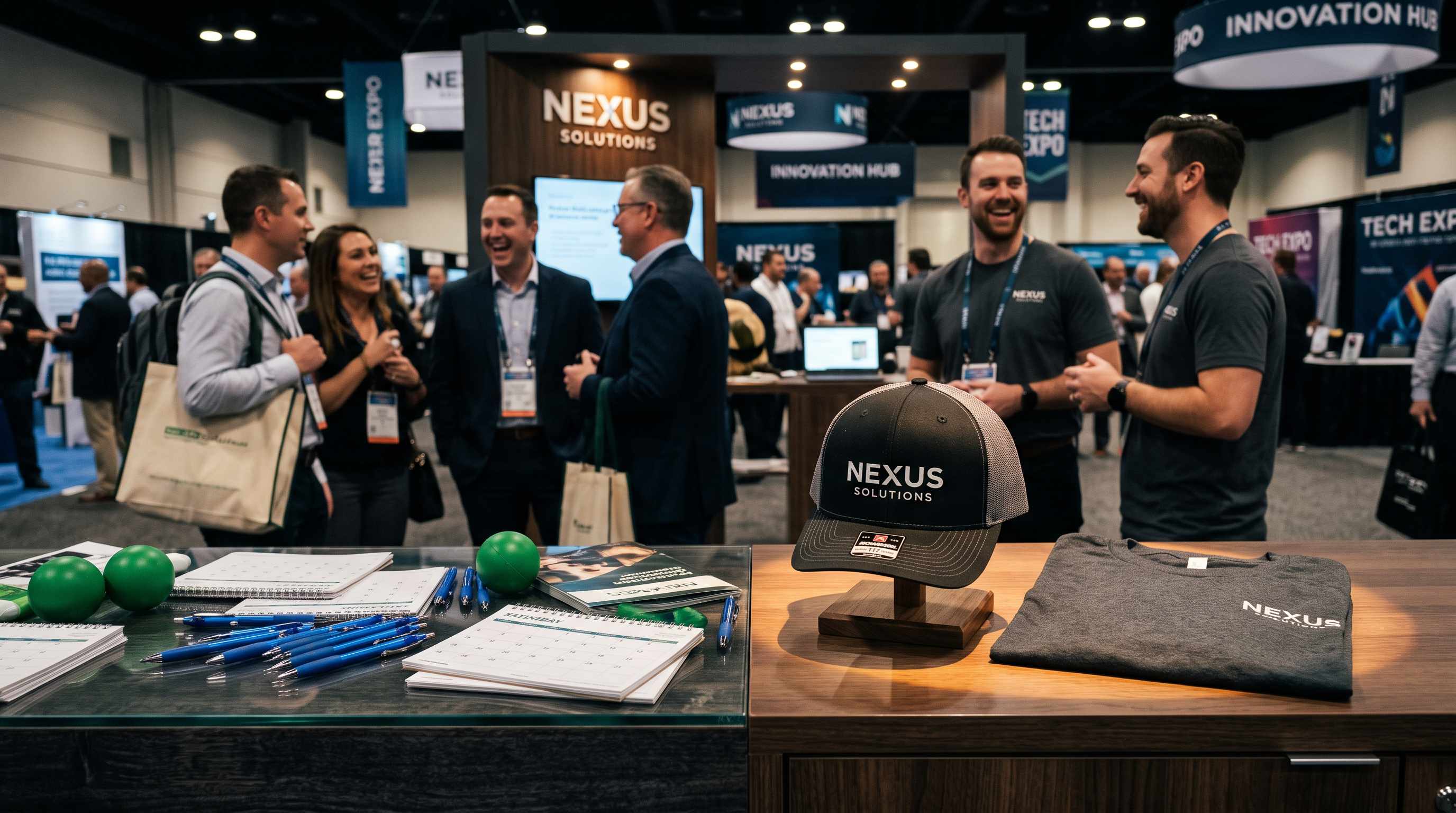
An unwanted promotional jacket goes in the trash 11% of the time, an unwanted hat 25%, an unwanted calendar 48%. The rest get passed along to someone else (ASI Global Ad Impressions Study, 2019). That is the whole argument for wearables as trade show giveaways. A hat or a shirt leaves the hall on a person, or with a person, while a calendar leaves in the hotel bin.
Most lists stop at ideas. This guide covers which wearable to give which visitor, how many to order, how to handle sizes, and when to place the order.
What Are the Best Trade Show Giveaways?
The best trade show giveaways are wearables: a hat, a T-shirt, a polo, or a jacket. They are the items people remember getting: in ASI's 2019 study, 85% could name the company that gave them a shirt or hat. Jackets, polos, and tees are also among the items least likely to be thrown out. The hat is the exception, and that is why it has to be a good one.
ASI's 2019 study measured every common booth item the same way, so the table below uses that one study for every row. Impressions are the study's estimate of how many people see the item over its life, and the cost column uses the study's own example prices.
| Giveaway | Own one | Kept | Lifetime impressions | Cost per impression (study example) | Thrown away when unwanted |
|---|---|---|---|---|---|
| Jacket or fleece | 67% | 16 months | 6,100 | 0.3 cents ($20 jacket) | 11% |
| T-shirt | 80% | 14 months | 3,400 | 0.2 cents ($7 tee) | 18% |
| Polo | 65% | 13 months | 2,300 | 0.4 cents ($10 polo) | 17% |
| Hat | 69% | 10 months | 3,400 | 0.3 cents ($10 hat) | 25% |
| Pen | 89% | 9 months | 3,000 | under 0.1 cents ($1 pen) | 25% |
| Calendar | 52% | 8 months | 850 | 0.3 cents ($3 calendar) | 48% |
Bags and drinkware fall between the wearables and the pens on months kept. A bag is kept about 11 months and earns 3,300 impressions; drinkware 12 months and 1,400.
The hat row cuts both ways. A hat is kept for the fewest months of the four wearables, yet it matches the tee on lifetime impressions. It gets worn outside, where strangers see it. A third of the men in that study wear a promotional hat at least once a week. If you want to look as you read, you can browse the custom hats collection; every hat named below is in it.
In ASI's 2023 update, caps, tees, and outerwear all scored higher, and pens and totes fell further behind. Caps went to 3,380 impressions, with 56% of people saying they'd keep and wear one for at least a year. T-shirts went to 5,053 and outerwear to 7,856, while pens and tote bags landed at 2,436 and 1,940 (ASI 2023 Ad Impressions Study).
At a booth, the jacket, the tee, and the hat do three different jobs; the polo mostly goes on your own staff. The jacket is kept longest and earns the most impressions, and it costs the most, so a few people get one. The tee reaches the most people for the least money. The hat fits nearly everyone without a size question, so it is the one you can hand out freely.
Which Trade Show Giveaways Do People Keep?
People keep the giveaway they'd have bought anyway, in a quality they'd have paid for, if they don't already own six of it. PPAI's 2025 consumer study puts a number on each part of that. The forum threads where attendees list the trade show swag they keep say the same, and it comes down to four checks.
It gets used or worn in public. Being useful is the top reason people keep a promotional item, named by 68% in the PPAI study (PPAI, The 5-Second Impact, 2025). A hat worn to a job site or a tee worn to the gym passes. A stress ball does not, whatever the imprint says.
The quality survives a wash. The same share, 68%, keep an item because it's well made, and poor material or build is the first thing that makes one feel cheap. Attendees say hats get worn if they're the good ones, and the shirts that stay in rotation are made of decent fabric. The cheap tees become sleep shirts and car-wash rags.
They don't already own six. More than a third of people say an item feels cheap because they have too many like it, and totes are the clearest case. The most-upvoted reply in a 456-comment thread on conference swag was a plea for no more tote bags. The writer had about 100 in a cabinet, and everyone already got a bag at the door.
It leaves the hall easily. Anything that won't pack flat or clear airport security stays in the hotel room, and the same threads are full of abandoned tumblers. A hat and a folded shirt fit in a carry-on.
Design decides the rest. The unique giveaway gets grabbed first and worn least. The joke tee and the odd novelty go quickest at the booth and rarely survive the purge at home. The shirt someone is still wearing three years later carries a clean logo, kept small, or artwork good enough to stand on its own. In the PPAI study, 89% said design is what decides whether they keep something.
One heavy-equipment sales rep summed the whole test up in a forum thread. He hands out good structured hats and runs out at every show. Prospects come back a year later wearing last year's hat to trade it in, some before they've bought a thing. His worst giveaway was a beach frisbee; he handed out the last of that order years after the event it was bought for.
Hats or Apparel: Which Wearable for Which Visitor
Give the hat to anyone who stops, and save the sized pieces for the people you talked to.
A hat with an adjustable closure fits almost every adult, so you can hand it across the table without asking anything. A shirt or a quarter zip has a size, and the only person you can ask is the one standing in front of you.
Experienced exhibitors already stock their booths this way, whether or not they'd call it a rule. The cheap grab items sit on top of the table. The ball caps and hoodies live under the counter and come out for the people the team has qualified in conversation. At one booth they come out only for existing customers.
| Wearable | Who gets it | Sizing at the booth | Kept (ASI 2019) | Lifetime impressions |
|---|---|---|---|---|
| Hat, adjustable closure | Anyone who stops and talks | One size fits most; nothing to ask | 10 months | 3,400 (3,380 in the 2023 edition) |
| T-shirt | Leads and booked meetings | Ask the size; hold the middle sizes | 14 months | 3,400 (5,053 in 2023) |
| Polo | Booth staff; corporate or formal shows | Poll staff ahead; leads by size | 13 months | 2,300 |
| Quarter zip, hoodie, fleece, or jacket | Booked meetings and top prospects | Ask the size; small counts | 16 months | 6,100 (7,856 in 2023) |
On the hat side, the closure is the whole sizing question. Snapback, buckle strap, and hook-and-loop closures fit most adult heads. Four adjustable hats we customize that work as the open-table giveaway:
- YP Classics 6245CM: an unstructured cotton twill dad hat that adjusts from 6 5/8 to 7 5/8 on a buckle strap.
- New Era NE200: a structured cotton cap with a hook-and-loop strap, one size.
- Carhartt CT103938: a washed cotton canvas cap, hook-and-loop, one size. The Carhartt label sewn on the side does some of the talking at an industrial show.
- Richardson 112: a structured trucker with a snapback closure, one of our best sellers by quantity.
Sized caps exist too, and belong with the apparel: the Richardson 172, a stretch performance cap with a mesh back, comes in S/M and L/XL. The Flexfit 6277 comes in S/M, L/XL, and XL/2XL. Both are good hats to hand to someone whose size you asked. On the open table they mean two stacks and a guess, which is the complaint welders make about fitted caps.
For a winter show, a beanie does the hat's job. The Richardson 146R is a cuffed acrylic knit in one size. Beanies take embroidery and patches but not printing, so a full-color logo goes on as a patch.
Apparel is the sized tier. A T-shirt reaches the widest range of people; a polo suits booth staff and the more formal shows, where a tee reads as casual. A quarter zip, hoodie, or fleece is the piece for a booked meeting: outerwear is kept longest, earns the most impressions, and costs the most. Ask IT people or welders what swag they'd pick and the zip hoodie comes up first, with the welders adding that everybody already gives T-shirts.
Hats do not land with every crowd. Trades, sales, and outdoor crowds ask for them by name. Some desk-bound tech attendees call hats too niche and would rather have the hoodie or a pair of socks. If your show is a developer conference, weight the sized tier heavier and the hat tier lighter. You can browse custom apparel to compare tees, polos, quarter zips, and hoodies for that tier.
How Many Trade Show Giveaways Should You Order?
Order the wearable for the number of conversations your booth can hold, and order any open-table item for about a quarter of expected attendance. The published rules of thumb disagree because they count different people. One says 20% to 30% of attendees, a supplier page says 50% to 75%, and another 60% to 80% of booth visitors plus a buffer.
Attendance is the show's number; conversations are the only count that ties to a hat you hand to a person.
A merch planner on YouTube describes the mistake: 3,000 visitors, so you buy 3,000 stress balls. An exhibitor coach in another video plans a 400-attendee show around 40 qualified conversations, and that one-in-ten ratio is the base for the wearable tier.
- Open-table tier, if you run one. 20% to 30% of expected attendance. This is the grab bowl, and it earns a glance.
- Conversation tier: hats. Expected attendance times 10%, then add a 20% buffer. Check it against staffing: staff on the floor, times floor hours, times the conversations one person can hold in an hour.
- Sized tier: apparel. Booked meetings plus the top prospects you expect to qualify on the spot, counted by name, plus two or three extras in the middle sizes.
Take a 1,500-attendee show, three days, two staff: 150 conversations at 10%, so 180 hats with the buffer. Two staff over three seven-hour days is 42 staff-hours, so 150 conversations is about four an hour each, which a two-person booth can hold. Add 33 quarter zips or hoodies: 20 booked meetings, 10 walk-up prospects, and three extras in the middle sizes.
Now a 400-attendee regional show, one day, one staff member: 40 conversations, 48 hats, round to 50. One person over seven hours needs about six conversations an hour, busy but workable. Add 12 tees or polos: five booked meetings, five walk-ups, and two extras in the middle sizes.
The buffer exists because good hats run out, and the sales-forum threads say so over and over. One exhibitor brings about 200 tees a show and goes home empty every time. Another gave away 500 fly swatters before the first day ended, and the hat exhibitors are always empty before the show closes.
Leftovers are the cheaper mistake, provided the design carries no show name or date. An undated hat becomes next show's stock, or the crew's hat.
The price per piece falls as the order grows. Hats that share one design, one customization method, and one placement count together as a design group, whatever the mix of styles and colors. A 180-hat group costs less per hat than a 50-hat one. The current numbers are in our guide to custom hat prices by quantity. Griwolfe has no minimum on any customization method, so the regional show can be a 50-hat order and a first show a 25-hat one.
Sizing a Booth Apparel Order
Sized apparel only works at a booth when you hand it to someone you can ask, and three rules follow from that.
Aisle traffic never gets a sized item. A shirt on the open table is a guess, and the wrong sizes pile up. Exhibitors list "XL t-shirts" right next to cheap pens as the things that end up in landfill. Ordering the right size spread is a chore even when you know the crowd, so give the open table the hat.
Leads get asked. Your apparel count is the sized-tier count from the section above. Hold it in the middle sizes, M through XL, with one or two each of S and 2XL. When a lead earns the piece, ask the size and hand it over. Scarcity helps here: one exhibitor brought 50 zip jackets, told people only 50 existed, and watched a line form.
When the size is gone, take the address. Ship the right size after the show; for us that's a normal order, since there's no minimum. For you it's a follow-up email with a tracking number in it. Keep it in the same design so it matches what everyone else got.
Booth staff should wear the same shirt. Teams in matching shirts were the easiest to approach, according to a reviewer who spent a day judging booths at a large software conference. Poll the crew's sizes ahead of time and order their shirts with the lead-tier pieces. Garment sizes don't split a design group, so the staff shirts price with the lead-tier pieces.
A left-chest logo on a tee, polo, or quarter zip runs up to 4 by 4 inches, the small, clean logo attendees keep asking for. A full-front tee graphic is printed and runs up to 13 by 17 inches; a sleeve print runs up to 3.5 by 3.5. Standard production for embroidery and printing is 2 weeks from proof approval, the same as hats.
Planning Backward From the Show Date
Start from the day the boxes must be at the venue, not the day the show opens. Most shows let exhibitors ship to an advance warehouse that closes before move-in, or to the venue on a day the exhibitor kit lists. The other options are shipping to your hotel or carrying the boxes yourself. Whichever you choose, that delivery date is day zero, and everything below counts backward from it.
- Delivery date. The advance-warehouse cutoff, the venue's direct-ship day, or your hotel check-in, whichever applies to you.
- Shipping. Transit days from our facility in North Carolina to that address. U.S. shipping is free.
- Production. Standard production is 2 weeks for embroidery and printing, and 4 weeks for patch methods, counted from your proof approval.
- Proof review. We email a production-ready design proof within 1 to 2 business days of your order, with unlimited revisions. Add your own approval time here; a proof that sits in an inbox for a week costs a week.
- Design. One sitting in the Design Studio, where the logo shows on the actual hat or shirt before you order.
Add those steps together, count back from day zero, and you have the last safe order date. If the show is already inside that window, contact us by phone, email, or live chat before ordering. Rush service runs as low as 3 business days, and that call is how you arrange it.
Order the staff pieces and the giveaways together so everything arrives in the same boxes. Pick one person to approve the proof so it does not sit in an inbox. The full first-order walkthrough, from picking the hat to what happens after checkout, lives in our custom hats for business guide.
Frequently Asked Questions
Are custom hats a good trade show giveaway?
Yes, when the hat is good. In ASI's 2023 study, 56% of consumers said they would keep and wear a promotional cap for at least a year. A cap earns about 3,380 impressions over its life. An adjustable hat fits most adults with nothing to ask, and exhibitors on sales forums report running out of good hats at every show.
Hats or T-shirts: which booth giveaway gets kept longer?
T-shirts. ASI's 2019 study puts a promotional tee at 14 months kept against 10 for a hat, and the 2023 edition gives tees more lifetime impressions. The hat wins on fit: one size covers nearly everyone, and it costs the same per impression as a jacket. Use both, the hat for the crowd and the tee for leads.
How far in advance should I order trade show giveaways?
Count back from the venue delivery date. Allow shipping, then 2 weeks of production for embroidery or printing, or 4 weeks for patch methods. Add 1 to 2 business days for the proof and your approval time. That puts the order about four weeks out for embroidery and six for patches; rush runs as low as 3 business days.
Should I put the event name or date on the giveaway?
No. A hat or shirt with a show name on it stops being wearable the day the show ends, and any leftovers become dead stock. Keep the giveaway design undated with a clean logo, so extras carry to the next show and the wearer keeps wearing it. If you want the event on something, put it on the staff shirts.
What should our booth staff wear?
The same hat you are handing out, plus matching shirts in one design: polos for a corporate show, tees for a casual one. Matching staff are easier to spot and approach across a busy floor. Poll sizes ahead and order the staff pieces with the lead-tier apparel. They ship together and price as one group.
Before You Order
Five decisions cover a booth's trade show giveaways. Pick the one-size hat you'll hand to anyone who stops, and the sized piece you'll give to the people you talked to. Count the conversations your staff can hold and add a buffer to the hat tier. Keep the design undated with a clean, small logo. Then count backward from the venue delivery date rather than the opening day.
The order itself takes one sitting. Put the logo on the hat and the shirt, check them in the live preview, and approve the emailed proof before we make anything. Browse the Custom Hats collection →
Have a question about your order? Contact us. We'll get back to you the same day.
Share:
Custom Hat Design Ideas: 14 Looks Sized to Fit the Hat
Richardson 112 vs 115: Which Fits Your Head and Your Logo